Sue Townsend has written a whole series of Adrian Mole diaries. They've been around for years, but I've only just read one of them, namely The Prostrate Years. Hmmmm, very light-hearted, but it's quite amazing how a mixture of ordinariness, serious issues and the bizarre can actually be made to be humorous against a background of events occurring in the wider world.
That said, a little bit of it goes quite a long way, and while I'll possibly read other books in the series if I come across them, I don't think I'll be actively seeking them out!
Showing posts with label books writing and literature. Show all posts
Thursday, 11 September 2014
Tuesday, 2 September 2014
Good Food Guide
Although at the end of the day I like to make my own assessments, I do find it interesting to compare my thoughts with what the Good Food Guide says about restaurants.
Perhaps a little unusually, I find myself in agreement with the most recent edition's positive ratings of a couple of the restaurants in our area.
A couple of other local long-term inclusions have been dropped from this edition; perhaps regrettable for them, but on reflection probably under-standable. Expectations change, and sometimes it's not enough simply to keep doing things the same way. I think this applies to at least one (perhaps both) of the local places that have dropped out. My impression is that they're still doing things in much the same way as they have in the past. Perhaps this appeals to an established clientele, but it's not necessarily the way to keep your place in a guide that purports to be "up there" with the trends in the industry.
One thing about the Guide that I sometimes struggle with is the mapping. Of course, many of the restaurants reviewed are in concentrated pockets and others are widely dispersed, so a "one size fits all" mapping layout just wouldn't work. But the maps are a bit of a "mish-mash". It seems to me that they could be a little clearer.
Perhaps a little unusually, I find myself in agreement with the most recent edition's positive ratings of a couple of the restaurants in our area.
A couple of other local long-term inclusions have been dropped from this edition; perhaps regrettable for them, but on reflection probably under-standable. Expectations change, and sometimes it's not enough simply to keep doing things the same way. I think this applies to at least one (perhaps both) of the local places that have dropped out. My impression is that they're still doing things in much the same way as they have in the past. Perhaps this appeals to an established clientele, but it's not necessarily the way to keep your place in a guide that purports to be "up there" with the trends in the industry.
One thing about the Guide that I sometimes struggle with is the mapping. Of course, many of the restaurants reviewed are in concentrated pockets and others are widely dispersed, so a "one size fits all" mapping layout just wouldn't work. But the maps are a bit of a "mish-mash". It seems to me that they could be a little clearer.
Wednesday, 23 July 2014
Forbidden Fruit
I don't comment on every book I read, but I thought I ought to post something about Kerry Greenwood's Forbidden Fruit. I can handle Kerry's Phryne Fisher (here, for example), but the "detective" in this book is Corinna Chapman. I haven't read any of the previous Corinna Chapman books (I see that Forbidden Fruit is the 5th), so it took me a while to get up to speed on some of the context of this story. Even allowing for this, I'm sorry, but Corinna is just too over-the-top for me. Yes, there are some familiar place names, but there's too much food stuff, too many way-out characters, too many pets (sorry, "companion animals"), too much over-done description of Melbourne's (largely imaginary) "street scene".

Perhaps there's an audience for all this, but I ended up skimming the pages looking for the "story" - such as it is. The story meanders down numerous seemingly irrelevant byways and involves highly implausible characters. The trials and errors in the making of making of glacé cherries seem to get as much attention as the search for the runaway kids......and anyway, there's a recipe for glacé cherries when (nearly 300 pages later) you get to the end.
Tuesday, 8 July 2014
"Mad, bad and dangerous to know"
"Mad, bad and dangerous to know": it is said that this was Lady Caroline Lamb's description of Lord Byron (1788 - 1824), and it's been described as his "lasting epitaph".
I attended a lunch reflecting on Lord Bryon's life and times. In the course of a fascinating and insightful discussion, the proposition was advanced that had Byron not died when he was 35, there would have been nothing else for him to achieve in life!

The times in which he lived were, of course, tumultuous, and perhaps contributed to a "live for the moment" attitude.
Byron opposed Lord Elgin's removal of the Parthenon marbles from Greece, and "reacted with fury" when Elgin's agent gave him a tour of the Parthenon, during which he saw the missing friezes and metopes. His poem, The Curse of Minerva, was written to denounce Elgin's actions.
I attended a lunch reflecting on Lord Bryon's life and times. In the course of a fascinating and insightful discussion, the proposition was advanced that had Byron not died when he was 35, there would have been nothing else for him to achieve in life!

The times in which he lived were, of course, tumultuous, and perhaps contributed to a "live for the moment" attitude.
Byron opposed Lord Elgin's removal of the Parthenon marbles from Greece, and "reacted with fury" when Elgin's agent gave him a tour of the Parthenon, during which he saw the missing friezes and metopes. His poem, The Curse of Minerva, was written to denounce Elgin's actions.
Thursday, 3 July 2014
The Cudgewa Line
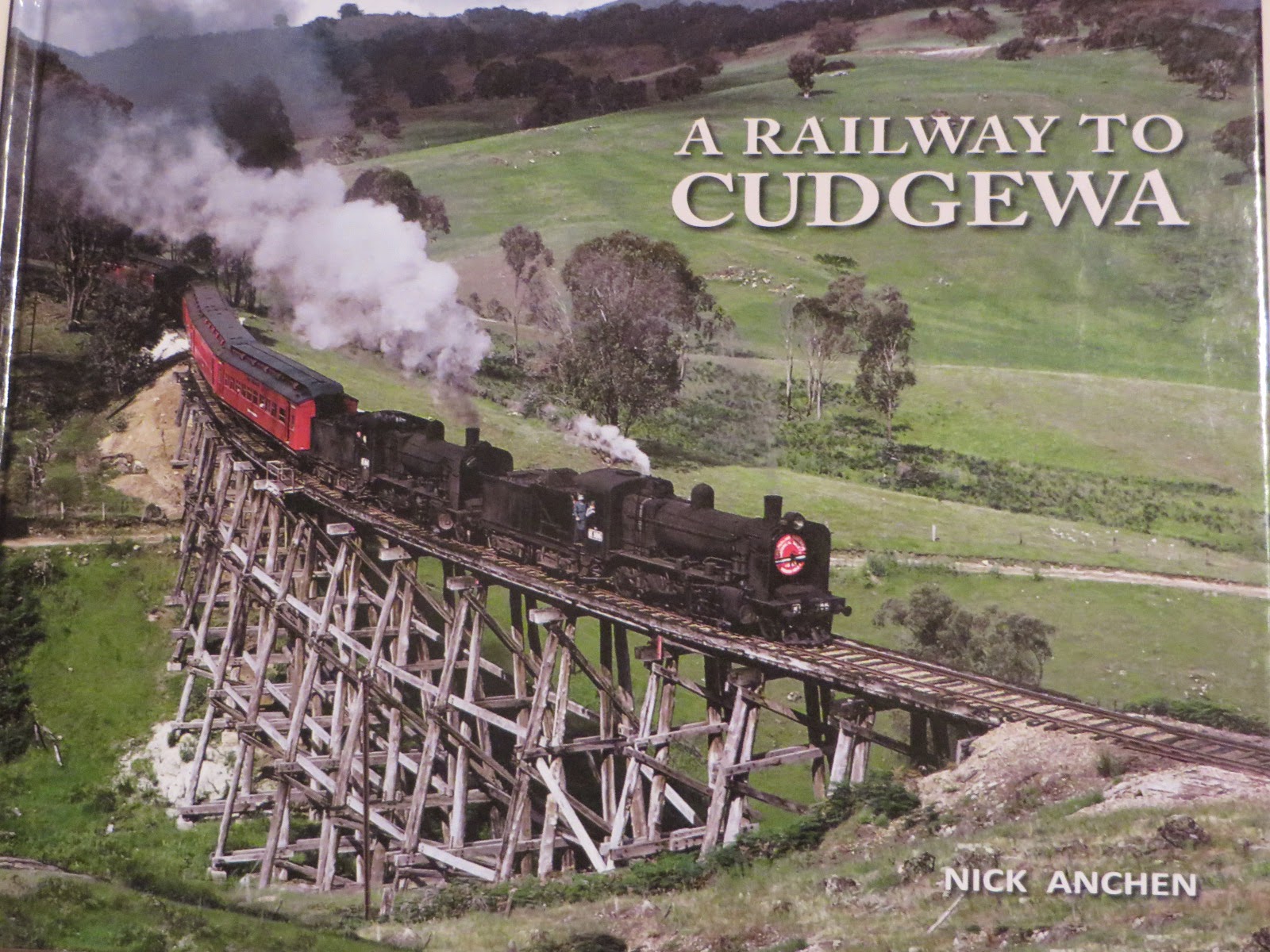
B lent me A Railway to Cudgewa by Nick Anchen.
This certainly brought back memories: in my younger days, I travelled twice on this line, once on a goods train and once on an ARHS excursion. I may even have some photos from that time, but I've yet to locate them. Although these trips were good fun at the time, we took so much for granted then, and only in hindsight do we appreciate what we experienced.
As every Victorian railway enthusiast knows, Shelley was the highest station on the Victorian railway network (2562 ft).
Back to the book: various chapters deal with the history of the line (including the relocation of the town of Tallangatta between 1952 and 1956), stories about the enginemen, the various trains that operated on the line, mishaps, the Snowy Mountains scheme traffic, the life of the bridge gangers and the eventual closure of the line. There are many photographs, which really do contribute greatly to the book.
This certainly brought back memories: in my younger days, I travelled twice on this line, once on a goods train and once on an ARHS excursion. I may even have some photos from that time, but I've yet to locate them. Although these trips were good fun at the time, we took so much for granted then, and only in hindsight do we appreciate what we experienced.
Back to the book: various chapters deal with the history of the line (including the relocation of the town of Tallangatta between 1952 and 1956), stories about the enginemen, the various trains that operated on the line, mishaps, the Snowy Mountains scheme traffic, the life of the bridge gangers and the eventual closure of the line. There are many photographs, which really do contribute greatly to the book.
Monday, 23 June 2014
The Speechmaker
We had to change our booking for MTC's The Speechmaker, but on attempting to do so, we were told it was fully booked. There was only one future performance at which two seats were available, and they weren't together. We took the seats and had no regrets because we quite enjoyed it, but we were able to see for ourselves why there has been a lack of critical acclaim.
It's a satire with some good one-liners, although perhaps overly-reliant on Australian clichés about the US, and the outcome has a sense of inevitability about it. Not far beneath the surface is a serious theme about the power exercised by the United States security agencies.
It's been created by the Melbourne-based Working Dog team, and presumably it is this connection that resulted in the production being sold out before opening night.
Many of the reviews haven't been complimentary, such as the Herald Sun, which was critical of the lack of depth and rather frantic movements at times (such as, does the revolving stage really have to be used so much?). Other reviews are here. and here.
Perhaps the best description came from a friend who has also seen the play, who suggested that there was sufficient content for an enjoyable 30 minute TV satire, rather than the 90 minutes (no interval) that are it actually takes.
It's a satire with some good one-liners, although perhaps overly-reliant on Australian clichés about the US, and the outcome has a sense of inevitability about it. Not far beneath the surface is a serious theme about the power exercised by the United States security agencies.
It's been created by the Melbourne-based Working Dog team, and presumably it is this connection that resulted in the production being sold out before opening night.
Many of the reviews haven't been complimentary, such as the Herald Sun, which was critical of the lack of depth and rather frantic movements at times (such as, does the revolving stage really have to be used so much?). Other reviews are here. and here.
Perhaps the best description came from a friend who has also seen the play, who suggested that there was sufficient content for an enjoyable 30 minute TV satire, rather than the 90 minutes (no interval) that are it actually takes.
Wednesday, 11 June 2014
Growing Up on the Railway in the South West
I'm afraid that when I see a second-hand book shop, I can't resist wandering in and checking the railway books section. So it was in Fremantle, where there's a branch of the Elizabeth's chain (pity there's no Elizabeth's in Melbourne).
I'm a bit selective about the types of book that I'm prepared to buy, and especially aren't attracted to generic books (such as "Steam Trains Around the World"). I look for books dealing with specific matters, such as researched histories of particular lines and reference materials (such as timetables). So, the title "Growing Up on the Railway in the South West" didn't appeal to me when I first saw it, but in the absence of anything else of interest, I bought it.
I'm glad I did, because it's quite interesting. It's a collection of recollections, all in the first person (but I suspect, told to the author) of a wide variety of people associated with the railways in the south west of Britain, especially (of course) the Great Western Railway. It covers engineers, shunters, signalmen, porters, clerical workers, engine drivers, crossing keepers as well as a passenger and a chaplain. There are reminiscences from before World War 2 right up to the publication date of 1998. One chapter concerns the clerical worked who started work in 1917! He retired in 1966, but apparently was still around at the time the reminiscences were being collected. Thus, it touches on the effects of the depression, war, nationalisation, the passing of steam and the coming of diesels and there are even one or two mentions of privatisation.
A few impressions emerged. One is the length of time that some people worked on the railways. In a number of cases, they started quite young in a very junior role and retired over 50 years later (although of course long-serving employees were more likely to have been chosen by the compiler). One of the chapters is a daughter's recollections of her father who worked on the railway for over 40 years, but always refused promotion because it would have involved moving to a different town, even though his role was quite mundane (although there are also instances of people who progressed through the ranks to quite senior positions). And, especially in the pre-war era, transfers to other locations which today would seem to be quite close were regarded as going to a distant place!
Dr Beeching, and his widespread closures are frequently mentioned. As I've remarked before, his is a household name, even today in British railway circles!
Another impression was the large numbers of people employed: a contribution by a person who worked for many years as a shunter at the Swindon workshops refers to the fact that this establishment alone employed between 22,000 and 23,000 people (in the 1950s). I'm not sure of the basis for this figure, as I see from Wikipedia that the peak employment was 14,000 and the figure in the '50s would have been less. Perhaps the higher figure takes into account those employed in the proximity of the workshops, such as shunters and the like. Nevertheless, on any view, the railways were clearly very significant employers.
I'm a bit selective about the types of book that I'm prepared to buy, and especially aren't attracted to generic books (such as "Steam Trains Around the World"). I look for books dealing with specific matters, such as researched histories of particular lines and reference materials (such as timetables). So, the title "Growing Up on the Railway in the South West" didn't appeal to me when I first saw it, but in the absence of anything else of interest, I bought it.
I'm glad I did, because it's quite interesting. It's a collection of recollections, all in the first person (but I suspect, told to the author) of a wide variety of people associated with the railways in the south west of Britain, especially (of course) the Great Western Railway. It covers engineers, shunters, signalmen, porters, clerical workers, engine drivers, crossing keepers as well as a passenger and a chaplain. There are reminiscences from before World War 2 right up to the publication date of 1998. One chapter concerns the clerical worked who started work in 1917! He retired in 1966, but apparently was still around at the time the reminiscences were being collected. Thus, it touches on the effects of the depression, war, nationalisation, the passing of steam and the coming of diesels and there are even one or two mentions of privatisation.
A few impressions emerged. One is the length of time that some people worked on the railways. In a number of cases, they started quite young in a very junior role and retired over 50 years later (although of course long-serving employees were more likely to have been chosen by the compiler). One of the chapters is a daughter's recollections of her father who worked on the railway for over 40 years, but always refused promotion because it would have involved moving to a different town, even though his role was quite mundane (although there are also instances of people who progressed through the ranks to quite senior positions). And, especially in the pre-war era, transfers to other locations which today would seem to be quite close were regarded as going to a distant place!
Dr Beeching, and his widespread closures are frequently mentioned. As I've remarked before, his is a household name, even today in British railway circles!
Another impression was the large numbers of people employed: a contribution by a person who worked for many years as a shunter at the Swindon workshops refers to the fact that this establishment alone employed between 22,000 and 23,000 people (in the 1950s). I'm not sure of the basis for this figure, as I see from Wikipedia that the peak employment was 14,000 and the figure in the '50s would have been less. Perhaps the higher figure takes into account those employed in the proximity of the workshops, such as shunters and the like. Nevertheless, on any view, the railways were clearly very significant employers.
Monday, 26 May 2014
The Library renovations
The Council did some renovations at the local library a couple of months ago. As I said in my earlier post, I'm not quite sure what was achieved (apart from the expenditure of ratepayers' money). The service desk is now smaller, and a temporary table has been placed beside it to provide an additional position. The revised layout has involved the fiction area being swapped with the non-fiction area, and the newspaper/periodicals area being swapped with the children's area, but frankly the layout doesn't appear any more functional than previously.
But most notably, the previous higher shelving in the fiction area has been replaced by shelving that is significantly lower. Because there's been no increase in the total area area occupied by bookstacks, the result is that the library's capacity has been reduced.
Why has this occurred? I guess that there's some standard for libraries that requires every book to be accessible to a child? If so, the logic appears to be, well, if the result of having higher bookstacks is that the books on the highest shelf won't be readily accessible to a small percentage of users, then it's better not to have the books at all. Put another way, unless 100% of users can reach them, then the 95% of users who can reach them can't have them either! Is this really what "equal opportunity" (or whatever) is about?
What next? I see that tactile banknotes are on the agenda. And if it's impracticable to implement these, do we abolish banknotes?
But most notably, the previous higher shelving in the fiction area has been replaced by shelving that is significantly lower. Because there's been no increase in the total area area occupied by bookstacks, the result is that the library's capacity has been reduced.
![]() |
| No more than 4 shelves, please |
Why has this occurred? I guess that there's some standard for libraries that requires every book to be accessible to a child? If so, the logic appears to be, well, if the result of having higher bookstacks is that the books on the highest shelf won't be readily accessible to a small percentage of users, then it's better not to have the books at all. Put another way, unless 100% of users can reach them, then the 95% of users who can reach them can't have them either! Is this really what "equal opportunity" (or whatever) is about?
What next? I see that tactile banknotes are on the agenda. And if it's impracticable to implement these, do we abolish banknotes?
Monday, 28 April 2014
Neighbourhood Watch
The set is stark (as one reviewer put it, there's not much to distract the eye) and the flashbacks are disconcerting at times. MTC's Neighbourhood Watch is basically about two very different women dealing with aspects of their respective pasts and involves a mixture of humour and confrontation. Apparently, the play was written with Robyn Nevin in mind and she certainly carries it well. In fact, the entire cast was good (a few quick changes, too), save that Bella, the dog, didn't put in an appearance even though she's pictured in the publicity (we only heard her).

I guess the issue for me is that "confronting demons" just isn't my scene. So, it's issue of "it's me, not the performance", with the result that I was left a little cool by the play.
Edit - In thinking a little more about the play's lack of appeal, I guess the issue is that most of the play is taken up in identifying just what the "demons" are. They gradually emerge, bit by bit. Once the issues have been identified, there's not much more that can occur, and the outcomes were, perhaps, inevitable.
I guess the issue for me is that "confronting demons" just isn't my scene. So, it's issue of "it's me, not the performance", with the result that I was left a little cool by the play.
Edit - In thinking a little more about the play's lack of appeal, I guess the issue is that most of the play is taken up in identifying just what the "demons" are. They gradually emerge, bit by bit. Once the issues have been identified, there's not much more that can occur, and the outcomes were, perhaps, inevitable.
Wednesday, 23 April 2014
The ANZAC tradition
It appears a lot of money is to be spent on commemorating the centenary of the ANZAC landing next year. However, the amount involved has raised eyebrows, for example in this ABC report.
However, in academia, apparently the issue goes a lot deeper than the money. The matter is the subject of an article in the April 2014 issue of Quadrant (Mervyn F Bendle, The Military Historians' War on the Anzac Legend). Bendle's article identifies a group of historians, including (strangely?) some at the Australian Defence Force Academy, who have have described the tradition in such terms as "Anglo-Celtic ...Anzac mythology [and] military fable". There seems to be quite an overlap between these people and those behind the Honest History website.
Bendle particularly takes to task the views put forward in recent books by Prof Joan Beaumont (Broken Australia: Australians in the Great War) and James Brown (Anzac's Long Shadow: The Cost of our National Obsession), but along the way mentions a number of other historians who have, in one way or another, taken issue with a number of the traditional and popular views of Australia's military history.

Let me say at the outset that I haven't carefully read the books that Bendle mentions, but I was taken by Bendle's colourful description of them as contributions to "the campaign of denigration of what is seen as a 'festival of mythology'". Bendle quotes Brown as stating, "This year an Anzac orgy begins. A commemorative program that would make the pharaohs envious". Brown is an ex-Army officer and an academic at the Australian Defence Force Academy. Bendle describes Brown's view of the Digger tradition "as a sort of cultural cancer within the military, promoting mythical ideas about the capabilities of Australian soldiers, and giving them ideas above their station." Hmm, a the risk of drawing a conclusion here, it sounds as though Brown thinks the tradition pays insufficient respect to the dignity that ought to be afforded to military officers as trained at the Academy.
Bendle notes that another historian in this category is Peter Stanley (author of Bad Characters, Sex, Crime, Mutiny and the Australian Imperial Fire, and who is quoted in the ABC report linked above), who includes in his criticism of the Anzac tradition the fact that it "unfairly favours old Anglo-Celtic families who [have] direct connections with those who served in and lived through the Great War", thus discriminatorily excluding "non-Anglo-Celtic Australians".
Joan Beaumont (these days also a Canberra academic) is said to have a wider range of issues with the tradition. Summarised, her views appear to be that the tradition insufficiently reflects the role of the women on the home front (such as, having actually to read in letters from the front about the miseries), as well as obscuring the memory of the 1917 general strike. She sees issues of the war years as leading to Australia in the 1920s as polarised between volunteers and shirkers, conscriptionists and anti-conscriptionists, Protestants and Catholics, workers and bosses and radicals and reactionaries.
Perhaps indeed history is multi-faceted, but the thought crossed my mind that some of these views seem to be in a similar category to an American historian writing about the effect that Paul Revere's ride had on his horse!
I notice, however, that the Weekend Australian is having none of this doubting! In the issue of 19-20 April, there was both an article by Peter Cochrane, referring to Anzac Day having been "reborn" as an appreciation of the trauma suffered not only by those who were directly involved but also by later generations in a variety of ways. And in the review section of that issue, an extract from Patsy Adam-Smith's 1978 work, The Anzacs, was published (although perhaps this isn't entirely unconnected with the fact that the book itself is being republished).
However, in academia, apparently the issue goes a lot deeper than the money. The matter is the subject of an article in the April 2014 issue of Quadrant (Mervyn F Bendle, The Military Historians' War on the Anzac Legend). Bendle's article identifies a group of historians, including (strangely?) some at the Australian Defence Force Academy, who have have described the tradition in such terms as "Anglo-Celtic ...Anzac mythology [and] military fable". There seems to be quite an overlap between these people and those behind the Honest History website.
Let me say at the outset that I haven't carefully read the books that Bendle mentions, but I was taken by Bendle's colourful description of them as contributions to "the campaign of denigration of what is seen as a 'festival of mythology'". Bendle quotes Brown as stating, "This year an Anzac orgy begins. A commemorative program that would make the pharaohs envious". Brown is an ex-Army officer and an academic at the Australian Defence Force Academy. Bendle describes Brown's view of the Digger tradition "as a sort of cultural cancer within the military, promoting mythical ideas about the capabilities of Australian soldiers, and giving them ideas above their station." Hmm, a the risk of drawing a conclusion here, it sounds as though Brown thinks the tradition pays insufficient respect to the dignity that ought to be afforded to military officers as trained at the Academy.
Bendle notes that another historian in this category is Peter Stanley (author of Bad Characters, Sex, Crime, Mutiny and the Australian Imperial Fire, and who is quoted in the ABC report linked above), who includes in his criticism of the Anzac tradition the fact that it "unfairly favours old Anglo-Celtic families who [have] direct connections with those who served in and lived through the Great War", thus discriminatorily excluding "non-Anglo-Celtic Australians".
Joan Beaumont (these days also a Canberra academic) is said to have a wider range of issues with the tradition. Summarised, her views appear to be that the tradition insufficiently reflects the role of the women on the home front (such as, having actually to read in letters from the front about the miseries), as well as obscuring the memory of the 1917 general strike. She sees issues of the war years as leading to Australia in the 1920s as polarised between volunteers and shirkers, conscriptionists and anti-conscriptionists, Protestants and Catholics, workers and bosses and radicals and reactionaries.
Perhaps indeed history is multi-faceted, but the thought crossed my mind that some of these views seem to be in a similar category to an American historian writing about the effect that Paul Revere's ride had on his horse!
I notice, however, that the Weekend Australian is having none of this doubting! In the issue of 19-20 April, there was both an article by Peter Cochrane, referring to Anzac Day having been "reborn" as an appreciation of the trauma suffered not only by those who were directly involved but also by later generations in a variety of ways. And in the review section of that issue, an extract from Patsy Adam-Smith's 1978 work, The Anzacs, was published (although perhaps this isn't entirely unconnected with the fact that the book itself is being republished).
Wednesday, 9 April 2014
Legal Education
I was indebted to an article in the Australian for drawing my attention to a speech by (Victorian) Chief Justice Marilyn Warren (the Fiat Justitia lecture, a link to the text is here) regarding a number of aspects of legal education in Australia. Her speech covered quite a lot of ground, and it was good to see these issues getting some exposure.
One of the issues she mentioned is that the universities are producing far more law graduates than can ever be employed as a lawyer. On a per capita basis, the number is far higher in Australia than it is in the US. In one sense, this is not all bad news, because a law degree can be a good form of generalist education. After all, how many arts graduates are employed as historians or whatever their major may have been? Moreover, if the places in law courses aren't available, they will become even more elitist than they are now (I'm not sure that the brightest VCE students will necessarily become the best lawyers).
However, this seems to have the result that the universities are responding to the demand for places in law courses by turning law into a generalised degree that fails to include some matters the judiciary considers important. She didn't say this, of course, but my informal observation is that these days there is quite an emphasis on "sociological" subjects, dealing with human rights and similar issues. But she did say that the way in which subjects are taught has changed, and that the teaching in some core areas is, "at least disappointing and in many respects unsatisfactory." She also says that it, "it is unfortunate that law students typically spend years studying the law before they find out what it is like to practice law". And she sends a shot over the universities' bows, saying, "if the university sector persists with the generalist direction a solution for legal practice effectiveness is needed". She moots various possibilities, including an "admission to practice" exam (akin to the bar exam sin the US) or even a cap on the number of lawyers (the aspect that the Australian chose as the subject of its headline).
Justice Warren's speech is worth reading in its entirety. I hope the law schools take it on board.
However, this seems to have the result that the universities are responding to the demand for places in law courses by turning law into a generalised degree that fails to include some matters the judiciary considers important. She didn't say this, of course, but my informal observation is that these days there is quite an emphasis on "sociological" subjects, dealing with human rights and similar issues. But she did say that the way in which subjects are taught has changed, and that the teaching in some core areas is, "at least disappointing and in many respects unsatisfactory." She also says that it, "it is unfortunate that law students typically spend years studying the law before they find out what it is like to practice law". And she sends a shot over the universities' bows, saying, "if the university sector persists with the generalist direction a solution for legal practice effectiveness is needed". She moots various possibilities, including an "admission to practice" exam (akin to the bar exam sin the US) or even a cap on the number of lawyers (the aspect that the Australian chose as the subject of its headline).
Justice Warren's speech is worth reading in its entirety. I hope the law schools take it on board.
Friday, 14 March 2014
Donna Leon
The local library was closed for a few weeks so that they could "renovate" it. I'm not quite sure why this was required, because after it was all done, the service desk was smaller, the shelves had been changed around for no apparent reason and the seemingly functional carpet had been replaced. But there you go....
To avoid the onset of "library deprivation", I took out a couple of Donna Leon Commissario Brunetti books. I've read some of her work previously, and knew these would be safe; not too violent, so I could read them before going to sleep, and not too complex, which leaves me trying to pull all the loose ends together!
Beastly Things appealed to me. A Question of Belief seemed to meander around a bit, but got to a conclusion in the end, although as is often the case in Leon's work, a few of the "baddies" ended up ducking under the radar and the fate of the primary villain (or in this case, there may have been two of them) was merely to be caught up in the vagaries of the Italian "justice" system for an indefinite period with an uncertain outcome.
To avoid the onset of "library deprivation", I took out a couple of Donna Leon Commissario Brunetti books. I've read some of her work previously, and knew these would be safe; not too violent, so I could read them before going to sleep, and not too complex, which leaves me trying to pull all the loose ends together!
Beastly Things appealed to me. A Question of Belief seemed to meander around a bit, but got to a conclusion in the end, although as is often the case in Leon's work, a few of the "baddies" ended up ducking under the radar and the fate of the primary villain (or in this case, there may have been two of them) was merely to be caught up in the vagaries of the Italian "justice" system for an indefinite period with an uncertain outcome.
Thursday, 27 February 2014
Maigret
I haven't read many of Georges Simenon's Maigret books, but I recently read (and enjoyed) Maigret and the Ghost. I had no idea how many Maigret books there were until I read this New Statesman article (thanks B for alerting me to this). In fact, the article states that there are 75 of them and that Penguin are re-publishing them all, re-translated, at the rate of one a month.
I particularly liked the bit towards the end of the New Statesman article, to the effect that a number of the Maigret books were translated into English by Geoffrey Sainsbury. It seems that Sainsbury took some liberties with his transactions, often altering details. Nevertheless, his translations "were duly submitted for the author’s approval, which was always forthcoming. And for good reason: Simenon did not understand a word of English.”
Even though the New Statesman article says that Maigret is one of the few detectives in literature who is possessed of characteristics not shared by their creators, it seems that in one this respect, Maigret is similar to Simenon: In Maigret and the Ghost, the point is made that Maigret speaks hardly any English.

EDIT - I am uncertain if I've previously posted this item. I thought I had, but when I edited it to add an additional label, blogger posted (or reposted?) it under the current date. This has left me unsure of the position, so I'm putting it here.
FOOTNOTE: I now see that Simenon lived and worked for some years in the USA. This seems to throw doubt on the statement that he didn't speak much English!
I particularly liked the bit towards the end of the New Statesman article, to the effect that a number of the Maigret books were translated into English by Geoffrey Sainsbury. It seems that Sainsbury took some liberties with his transactions, often altering details. Nevertheless, his translations "were duly submitted for the author’s approval, which was always forthcoming. And for good reason: Simenon did not understand a word of English.”
EDIT - I am uncertain if I've previously posted this item. I thought I had, but when I edited it to add an additional label, blogger posted (or reposted?) it under the current date. This has left me unsure of the position, so I'm putting it here.
FOOTNOTE: I now see that Simenon lived and worked for some years in the USA. This seems to throw doubt on the statement that he didn't speak much English!
Monday, 10 February 2014
Private Lives
Noel Coward's Private Lives is a witty comedy, enjoyable because of the sharp dialogue and farcical story-line. Of course, it's all very light-hearted and 1930s-ish, but there's nothing wrong with that.

MTC's production has great sets making full use of the revolving stage. It includes a little music and singing. The different personalities of each the characters shine through - as do the traits that (it turns out) they share!
A good night out.

MTC's production has great sets making full use of the revolving stage. It includes a little music and singing. The different personalities of each the characters shine through - as do the traits that (it turns out) they share!
A good night out.
Monday, 27 January 2014
The National Library
I had never been to the National Library and, in fact, was only vaguely aware of its existence. But I was given a ticket (thanks, A) to a guided tour of the current temporary exhibition, "Mapping Our World - Terra Incognito to Australia". This is an impressive display of maps starting with some indigenous material and a Ptolemy map from about 90 AD (rediscovered in about 1300), and the amazing Venetian map by Fra Mauro. This is perhaps the highlight of the exhibition, given the size of the map and the complexities involved in bringing it from Venice to Canberra.
The exhibition then proceeds through the "discovery" era maps of the Portuguese, Dutch and of course Cook and the other English explorers and culminating in Flinders' "General Chart of Terra Australis or Australia". All very interesting indeed.
There's also a permanent exhibition in the "Treasures Gallery", which contains a display of maps, pictures, photographs and objects designed to illustrate episodes in Australian history. Again, the range of material on display is quite breath-taking.
As for the library itself, sorry, no bookstacks at all! I guess they must exist somewhere but seemingly are not for public access. There are various reading rooms (complete with arrays of computer terminals, as well as people reading hard copies). There are also some Leonard French windows - quite nice but not as impressive as the ceiling in Melbourne's National Gallery.
Edit: As we were leaving Canberra, I noticed a warehouse-type building with a National Library sign on it. Maybe the bookstacks are out in a warehouse, instead of on the shores of Lake Burley Griffin!
As for the library itself, sorry, no bookstacks at all! I guess they must exist somewhere but seemingly are not for public access. There are various reading rooms (complete with arrays of computer terminals, as well as people reading hard copies). There are also some Leonard French windows - quite nice but not as impressive as the ceiling in Melbourne's National Gallery.
Edit: As we were leaving Canberra, I noticed a warehouse-type building with a National Library sign on it. Maybe the bookstacks are out in a warehouse, instead of on the shores of Lake Burley Griffin!
Wednesday, 15 January 2014
Friends in High Places
I've read a few of Donna Leon's crime stories in the past,
and have generally enjoyed Commissario Guido Brunetti's investigations. Brunetti is a high-ranking police officer
in Venice, who takes his food and family seriously. He is usually confronted with both the bureaucracy and the corruption in Italian
life. He's mostly above such matters,
although he couldn't be described as perfect.
He doesn't hesitate to utilise the computer-hacking skills of his
co-worker, Signorina Elettra, for example, nor (occasionally) the connections
of his high-placed father-in-law.
Friends in High Places isn't a new book, but I came
across it a while back and put it aside for holiday reading, as I knew it would
be very readable. Brunetti is faced with
a range of issues, and effectively solves the main plot but is forced to leave
some issues unresolved - an outcome consistent with the imperfect society in
which he operates.
Saturday, 4 January 2014
Bunga Haven
I have been occupying some of my time
while at the beach reading Bunga Haven on Lake Bunga – an East
Gippsland Idyll. This is a local history by a friend who is a
foundation member of the co-operative that now owns the house,
Krystyna Thomas.
“Bunga Haven” is a house 5 km east
of Lakes Entrance that has been used as a residence and a guest house
at different times since 1885, and is now owned by a small
co-operative.
While I am not familiar with the area
described in the book, I was greatly impressed by the amount of work
that obviously went into it (as indeed is the case with most
histories of this type). As well as telling us the history of the
actual house, and its owners and occupiers over the years, we learn
about matters such as
the geological history of the area and aspects
of the indigenous occupation. Of course there are numerous anecdotes
and photographs, and it's all weaved together most readably. Naturally it will be most meaningful for those who are associated with Bunga Haven, but even though I am an "outsider", I enjoyed it too.Wednesday, 18 December 2013
Murder on the Ballarat train
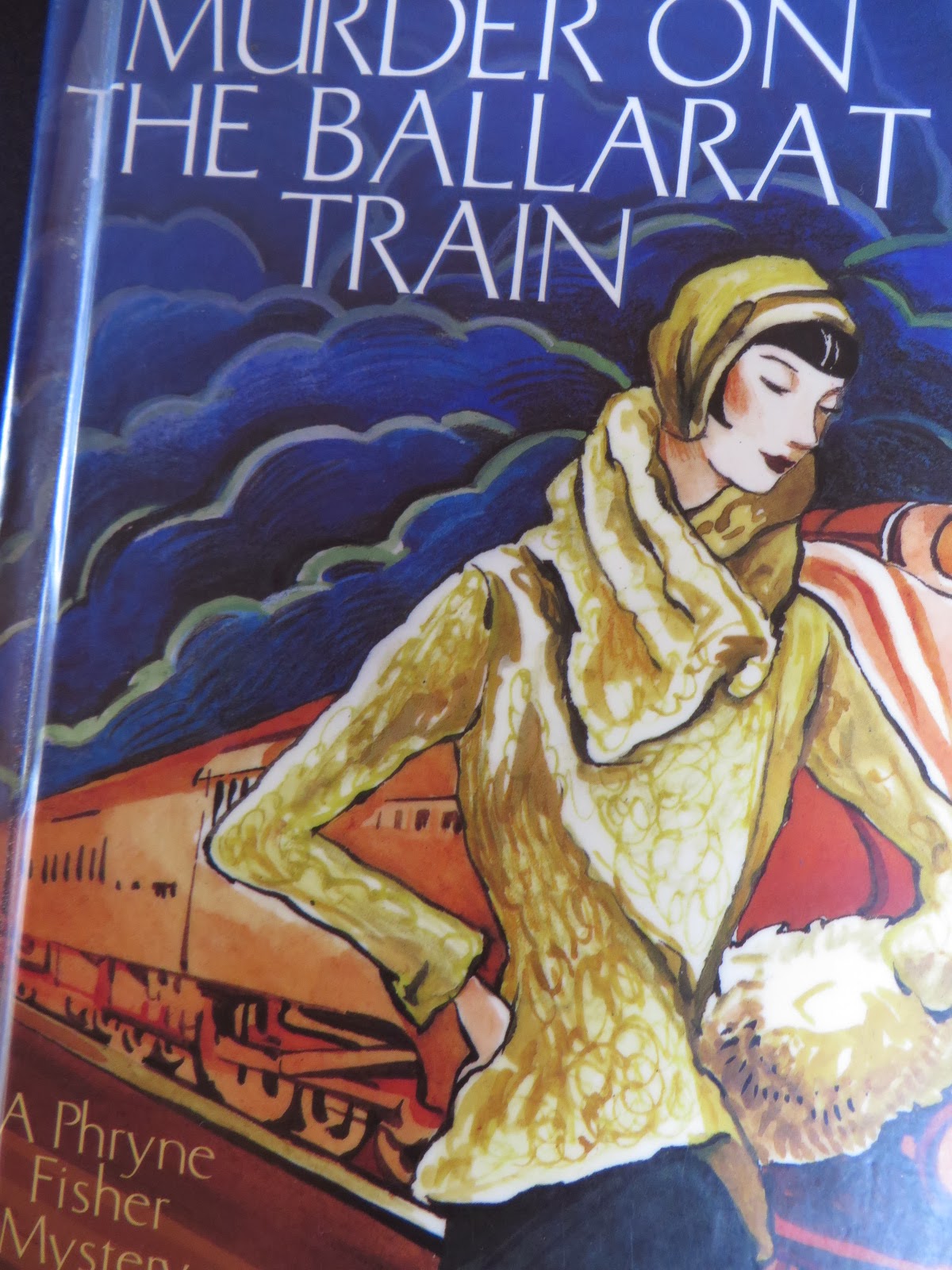
I blogged that Kerry Greenwood's research for Raisins and Almonds seemed to be quite impressive. So, when I came across Miss Phryne Fisher's investigations in Murder on the Ballarat Train, I wondered about the quality of the research for this book. Based on a fairly quick review, it doesn't seen to have been of the same standard as the Eastern Market mystery (which included a list of sources). I understand that Murder of the Ballarat Train dates from 1991, whereas Raisins and Almonds dates from 1997; perhaps the author became more interested in historical details as she developed as a writer?

In particular, it seems to me that Kerry may have taken a few liberties with the location of the murder. The closest timetable I could locate was a 1924 Working Timetable. The events in the book are set in 1928, so in theory there may have been some changes (but I doubt it). Assuming things in 1928 were similar to those in 1924, there was no train departing Flinders Street for Ballarat at 6 p m (see page 14) although there were trains departing Spencer Street for Ballarat at 5.05 and 7.09 pm. In fact, my impression is that it would have been very unusual indeed for Ballarat trains to have departed from Flinders Street. The murder is said to have occurred at a water tower about 10 minutes before Ballan (pages 28 and 140), but this could not have occurred, as the only water towers were at Bacchus Marsh and Ballan. There was an electric staff station at a small sttion called Ingliston, but no water.
A missed opportunity in the book is to refer to the long climb up the Ingliston Bank, between Bacchus Marsh and Ballan, which has also resulted in on optimistic schedule (1 hour 15 minutes after leaving the city) in the book (page 16) for the train to arrive at a point 10 minutes before Ballan. The 1924 train that departed Melbourne at 5.05 pm took 52 minutes between Bacchus Marsh and Ballan, mostly spent in climbing this bank (arriving at Ballan at 7.12 pm, over 2 hours after leaving the city), and the 7.09 pm departure took 54 minutes. The distance from Bacchus Marsh to Ballan is 17¾ miles, with a climb of 1323 feet. Although trains in 1964 still crawled up this bank, times are much improved today according to the V/Line timetables.
Ah well, the book is fictional in so many other ways, and quite a good read, so perhaps a few liberties can be excused!
In particular, it seems to me that Kerry may have taken a few liberties with the location of the murder. The closest timetable I could locate was a 1924 Working Timetable. The events in the book are set in 1928, so in theory there may have been some changes (but I doubt it). Assuming things in 1928 were similar to those in 1924, there was no train departing Flinders Street for Ballarat at 6 p m (see page 14) although there were trains departing Spencer Street for Ballarat at 5.05 and 7.09 pm. In fact, my impression is that it would have been very unusual indeed for Ballarat trains to have departed from Flinders Street. The murder is said to have occurred at a water tower about 10 minutes before Ballan (pages 28 and 140), but this could not have occurred, as the only water towers were at Bacchus Marsh and Ballan. There was an electric staff station at a small sttion called Ingliston, but no water.
| No "W" symbol between Bacchus Marsh and Ballan in 1964 |
A missed opportunity in the book is to refer to the long climb up the Ingliston Bank, between Bacchus Marsh and Ballan, which has also resulted in on optimistic schedule (1 hour 15 minutes after leaving the city) in the book (page 16) for the train to arrive at a point 10 minutes before Ballan. The 1924 train that departed Melbourne at 5.05 pm took 52 minutes between Bacchus Marsh and Ballan, mostly spent in climbing this bank (arriving at Ballan at 7.12 pm, over 2 hours after leaving the city), and the 7.09 pm departure took 54 minutes. The distance from Bacchus Marsh to Ballan is 17¾ miles, with a climb of 1323 feet. Although trains in 1964 still crawled up this bank, times are much improved today according to the V/Line timetables.
Ah well, the book is fictional in so many other ways, and quite a good read, so perhaps a few liberties can be excused!
Tuesday, 3 December 2013
Blessed are Those who Thirst
The author, Anne Holt, is described on the cover as being "the Godmother of modern Norwegian crime fiction". In an effort to diversify the range of crime writers that I read, I picked the book up in the library.

I guess any crime writing necessarily has to be about the characters involved as well as the crime, but in this book, the studies of the characters take precedence over the crime investigation, even though the murders are bizarre in the extreme. The detective is in a long-term lesbian relationship but still struggles with "coming out", the murder victims are refugees, there's a sordid rape to complicate matters which sets the victim's father on the investigative trail thus complicating his relationship with his daughter and so it goes on.
In short, I didn't warm to this book and I struggled to get through it.
I guess any crime writing necessarily has to be about the characters involved as well as the crime, but in this book, the studies of the characters take precedence over the crime investigation, even though the murders are bizarre in the extreme. The detective is in a long-term lesbian relationship but still struggles with "coming out", the murder victims are refugees, there's a sordid rape to complicate matters which sets the victim's father on the investigative trail thus complicating his relationship with his daughter and so it goes on.
In short, I didn't warm to this book and I struggled to get through it.
Friday, 22 November 2013
Raisins and Almonds
I recently commented on one of Kerry Greenwood's Miss Fisher books (Urn Burial) and although I was a little cool on that occasion, when I came across Raisins and Almonds, I thought I'd give Ms Greenwood - and Miss Fisher - another chance. This was particularly in light of the fact that the Miss Fisher series on ABC TV is apparently very well regarded by some, although I haven't seen any it. This isn't surprising as, apart from the news, I watch very little TV.
Raisins and Almonds isn't new (it was first published in 1997) and is about a murder in Melbourne's Eastern Market in the 1920s. The mystery requires Miss Fisher to engage closely with the Jewish community. I was more impressed with this book than with Urn Burial, particularly as the author has obviously researched not only Melbourne's geography of the era but also the Jewish community of the era. I can't speak about the accuracy of the latter (although a list of sources is set out), but certainly her description of Melbourne's geography and in particular the 1920s Eastern Market rings true. I have very early childhood memories of the Eastern Market before it was replaced by the then ultra-modern Southern Cross Hotel. To think that the Southern Cross Hotel (where the Beatles stayed when they came to Melbourne)- has in turn been replaced by an office building. But I digress.....
Apart from this, the Miss Fisher theme is there: a dalliance (I can live without this aspect, but perhaps these things are expected of modern authors?) and several separate threads to be unravelled. Of course, Miss Fisher sorts everything out. It just seems all too easy.
Raisins and Almonds isn't new (it was first published in 1997) and is about a murder in Melbourne's Eastern Market in the 1920s. The mystery requires Miss Fisher to engage closely with the Jewish community. I was more impressed with this book than with Urn Burial, particularly as the author has obviously researched not only Melbourne's geography of the era but also the Jewish community of the era. I can't speak about the accuracy of the latter (although a list of sources is set out), but certainly her description of Melbourne's geography and in particular the 1920s Eastern Market rings true. I have very early childhood memories of the Eastern Market before it was replaced by the then ultra-modern Southern Cross Hotel. To think that the Southern Cross Hotel (where the Beatles stayed when they came to Melbourne)- has in turn been replaced by an office building. But I digress.....
Apart from this, the Miss Fisher theme is there: a dalliance (I can live without this aspect, but perhaps these things are expected of modern authors?) and several separate threads to be unravelled. Of course, Miss Fisher sorts everything out. It just seems all too easy.
Subscribe to:
Comments (Atom)