Showing posts with label Europe. Show all posts

Monday, 15 September 2014

Travelling

I'm about to head off for a trip mainly for the purpose of walking in the High Tatras, but also spending a few days in London (on the way over) and Berlin (on the way back).    I've set up a dedicated blog for this.  Here's the link to it:
http://europetravel2014.wordpress.com/
The border shown is between Poland and Slovakia


So, I'm closing off this blog, at least for now.  

After that.....perhaps I'll establish a fresh day-to-day blog on my return?

Thursday, 7 August 2014

Tracking aircraft

The loss of MH17 was a true disaster.    It's a bit sobering to reflect that this is the very flight we travelled on last October (from Amsterdam to Kuala Lumpur).

However,  I was interested in the map that appeared on the internet shortly after the event, showing that hardly any commercial aircraft were near Ukraine.
On closer investigation, I find that you can see the location of a lot of the world's commercial  flights (including corporate planes) at Flightradar 24 and at Planefinder.   These sites use information transmitted from planes, particularly from ADS-B transponders (but also other sources).  They take a moment to load, but it's fascinating that this information is available to the world on just a click of the mouse button.  There are clearly some committed people out there that go to all this effort.

Just the same, some of the information looks a bit dodgy, particularly on Planefinder.  This site appears list a number of Aeromexico flights in Australia, but I think they are actually Pel-Air Aviation flights (do they use a similar flight prefix - perhaps something like AM)?   Also, Planefinder appears not to have a good coverage of China, but this doesn't seem to be an issue on Flightradar24.   Perhaps there are other strengths and weaknesses, too, but who's complaining, as the sites don't even carry advertisements. 

Tuesday, 29 July 2014

The Flag

What happens to the Union Jack and even the Australian flag if the Scots vote for independence   (and here)?  There was an article in the Australian about this (sorry about the paywall), but the essence was that if Scotland became independent, then logically the St Andrew's Cross would be removed from the Union Jack.    Then the issue would arise as to whether a consequential change would be made to the Australian flag.    Of course, this is all entirely speculation at present and involves several layers of "what ifs" ......

The article in the Australian suggested that the Australian flag could end up looking like the flag on the far right.  Well, maybe, but doesn't the blue background come from the St Andrew's flag?    Why would this be retained?   The stripped down Union Jack - assuming that this came about - would presumably have a white background because the two remaining components,  St George's cross and St Patrick's cross, both have white backgrounds. 

One possibility would be to take the opportunity to change the Australian flag, but the big question is, to what?   Please, let's not move away from the present flag until we know what we'd get instead.   And for the record I don't much like the design being promoted by one group (left).

Monday, 30 June 2014

28 June

As reported quite widely, 28 June 2014 (Saturday) marked the centenary of the assassination of Archduke Franz Ferdinand and his wife in Sarajevo by Gavriol Princip.   I am no historian, but while this may have been one of the events in the lead up to World War 1, it was by no means the only factor involved, as discussed here and also here.

Latin Bridge
For Serbs, the day is also of significance, as it is Vidovdan. (St Vitus Day) .

Plaque marking the spot from which the shot was fired


Wednesday, 11 June 2014

Growing Up on the Railway in the South West

I'm afraid that when I see a second-hand book shop, I can't resist wandering in and checking the railway books section.  So it was in Fremantle, where there's a branch of the Elizabeth's chain (pity there's no Elizabeth's in Melbourne).

I'm a bit selective about the types of book that I'm prepared to buy, and especially aren't attracted to generic books (such as "Steam Trains Around the World").  I look for books dealing with specific matters, such as researched histories of particular lines and reference materials (such as timetables).    So, the title "Growing Up on the Railway in the South West" didn't appeal to me when I first saw it, but in the absence of anything else of interest, I bought it.
 
I'm glad I did, because it's quite interesting.   It's a collection of recollections, all in the first person (but I suspect, told to the author) of a wide variety of people associated with the railways in the south west of Britain, especially (of course) the Great Western Railway.   It covers engineers, shunters, signalmen, porters, clerical workers, engine drivers, crossing keepers as well as a passenger and a chaplain.  There are reminiscences  from before World War 2 right up to the  publication date of 1998.  One chapter concerns the clerical worked who started work in 1917!  He retired in 1966, but apparently was still around at the time the reminiscences were being collected.  Thus, it touches on the effects of the depression, war, nationalisation, the passing of steam and the coming of diesels and there are even one or two mentions of privatisation. 


A few impressions emerged.  One is the length of time that some people worked on the railways.   In a number of cases, they started quite young in a very junior role and retired over 50 years later (although of course long-serving employees were more likely to have been chosen by the compiler).   One of the chapters is a daughter's recollections of her father who worked on the railway for over 40 years, but always refused promotion because it would have involved moving to a different town, even though his role was quite  mundane (although there are also instances of people who progressed through the ranks to quite senior positions).  And, especially in the pre-war era, transfers to other locations which today would seem to be quite close were regarded as going to a distant place!

Dr Beeching, and his widespread closures are frequently mentioned.   As I've remarked before, his is a household name, even today in British railway circles!

Another impression was the large numbers of people employed:  a contribution by a person who worked for many years as a shunter at the Swindon workshops refers to the fact that this establishment alone employed between 22,000 and 23,000 people (in the 1950s).  I'm not sure of the basis for this figure, as I see from Wikipedia that the peak employment was 14,000 and the figure in the '50s would have been less.  Perhaps the higher figure takes into account those employed in the proximity of the workshops, such as shunters and the like.  Nevertheless, on any view, the railways were clearly very significant employers.

Tuesday, 10 June 2014

Italian Masterpieces from the Prado

The exhibition at the National Gallery covers three centuries of Italian art, from the Prado's collection.    Of course, Europe was a different place in those days, with Spanish rule extending at times into parts of what is now Italy.

Titian, Salome with the Head of John the Baptist
I can't claim to know a lot about Renaissance art, but I certainly enjoyed the exhibition, in fact more than I expected.  It covers three centuries from Raphael onwards.
  
The captions are comprehesive, describing both the individual pictures as well as the various themes.
Raphael, Holy Family with St John


We attended on the Sunday afternoon of the long weekend, so of course there were a lot of people present.  Even so, it was not over-crowded, but we were glad we'd pre-purchased tickets as there was a long, slow-moving queue to buy them on the spot (this had eased off later in the afternoon).


However, with tickets in hand, there were no delays at the entrance at all.  If you think you may wish to return, ask for a pass-out as you exit into the shop.

Also, on display, just off the lobby, was also a special exhibition of William Blake's works, although mostly etchings.

And, if you go, allow a few minutes to admire the bears in the lobby area.  Kitsch, yes, but amusing.

Friday, 6 June 2014

D Day - 70 years on

D Day, the day on which the Normandy landings ("Project Neptune") commenced,  occurred on 6 June 1944, seventy years ago.  As is well known, this was the largest ever seaborne landing.

I don't underrate the historical significance nor the challenging logistics of the operation, but I do think the extent of Australia's participation in it needs to be kept in perspective:  there were about 3000 Australians involved.

The context,  as Wikipedia tells us,  is that 160,000 troops crossed the English Channel on D-Day, with 875,000 men disembarking by the end of June and presumably there were many more involved with the air and naval support (I see that most of the Australians were in these areas).

I do find it interesting how particular historical events are commemorated, and others are hardly mentioned.   Perhaps it's understandable that we don't hear much about one of the great turning points in the war, the Battle of Stalingrad, but there are probably other events that also remain in the background (the Battle of El Alamein comes to mind).  Presumably,  an element of selectivity is inevitable when thinking about historical matters, but it is interesting to reflect on how the "selection" process operates.

Monday, 2 June 2014

Publicity

Reading the local Serbian language newspaper, we were interested to see a photo of Julie Bishop, and an advertisement to the general effect that the Australia government was monitoring how it could assist in the flood relief efforts in the Balkans.

But, wait, what's the advertisement immediately below?  Oh, it's in support of the appeal to pay Captain Dragan's legal costs!   Captain Dragan is, to say the least, "controversial" (see undated but probably a little out of date report here).

This is hardly a cause that the Australian Government would be expected to support!  I'm assured that the placement would have raised a few smiles amongst the readership!


Friday, 23 May 2014

Monitoring social media

The following comment appeared on my post about the flooding in Serbia:
"Hello,
just wanted to let everyone know that you can support the victims of the flooding by playing the lotto. Here at Multilotto, we are giving €1 for every line played. Learn more here: http://www.multilotto.com/en/lotterynews/408-support-serbia-and-bosnia Whether you play the lotto or do something else entirely, please do what you can to support the victims of flooding in these difficult times.
Thank you."

The drama is on-going
Well, I like to receive comments, and the idea of providing financial assistance for the victims of the floods is commendable.  However,  I removed the comment because playing lotto on a non-Australian website doesn't seem the best way of supporting the victims (I understand that other ways of assisting them are under consideration).

Just the same, it's interesting that my rather obscure blog post was quickly picked up by the person who made the comment.   Obviously, there are some powerful tools out there monitoring the social media!  There was a similar instance here.

Tuesday, 20 May 2014

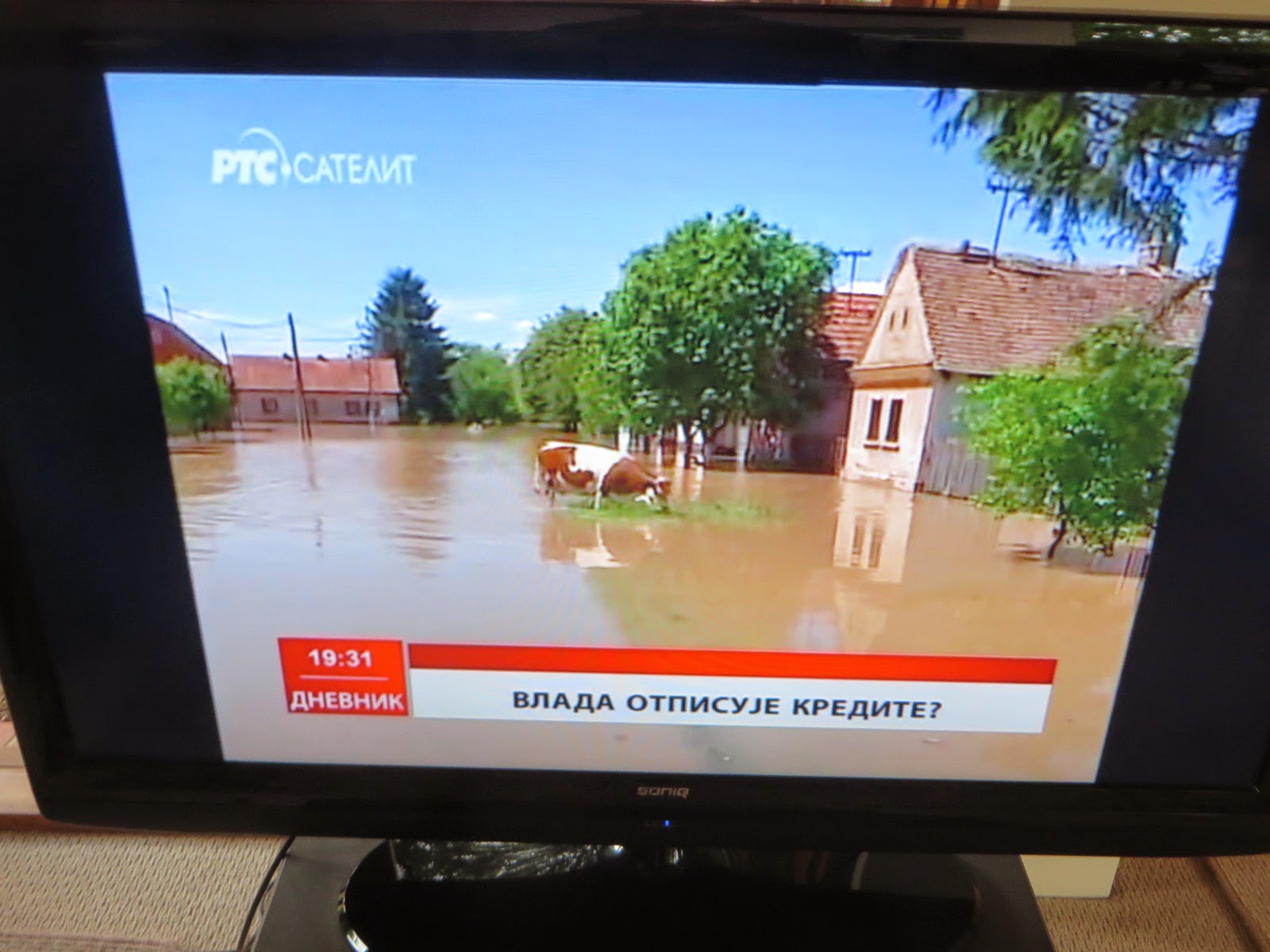
Floods in Serbia

There has been some mention in the news of floods in the Balkans, and we were disturbed to receive a text from the cousins in Obrenovac (on the River Sava flood plain, and apparently one of the worst hit cities) to the effect that their whole town has been flooded and the family has been forced to find accommodation with friends and relatives.

At this stage, they don't know when it will be possible to return to their home, but early indications are that it might not be for some time.   Unfortunately, there's not a lot that can be done from this distance to relieve the situation.


Update:   we have now spoken to one of the displaced cousins.  Naturally they are finding the whole situation distressing.  They're critical of the lack of warning they received and the general "unresponsiveness" of the authorities (notwithstanding that the TV images convey a different impression).


Monday, 18 February 2013

The Edict of Milan

February 2013 represents the 1700th anniversary of the Edict of Milan.

This granted all persons in the Roman Empire freedom to worship whatever deity they pleased, assured Christians of legal rights (including the right to organize churches), and directed the prompt return to Christians of confiscated property.  Previous edicts of toleration had been as short-lived as the regimes that sanctioned them, but this time the edict effectively established religious toleration. 
Statue of Constantine at York Minster

Geoffrey Blainey regards the edict as one of the great turning points in the history of the world.  Lord Norwich ranks this decision, and the decision to establish Constantinople as capital of the Roman empire (dedicated on 11 May 330), as decisions which "changed the future of the civilized world".

Constantine's decision was influenced by the vision of a cross of light in the heavens he is said to have seen on 28 October 312  just before or perhaps during the battle of the Milvian Bridge, against his brother-in-law Maxentius.

In February 313, Constantine I, emperor controlling the western part of the Roman Empire and Licinius, controlling the Balkans, met in Milan and, among other things, agreed to treat the Christians benevolently. Wikepiedia states that it is debatable whether or not there was in fact a formal 'Edict of Milan', but that it took the form of letters by Licinius, a pagan, to the governors of a number of provinces.   However, John Julius Norwich (in A Short History of Byzantium) quotes the text of a joint edict.

Constantine's policy went beyond tolerating Christianity: he tolerated paganism and other religions, but he actively promoted Christianity, and he ordered the building of St Peter's basilica in Rome.     Laws such as one made in 319 prohibiting the murder of slaves and one in 321 proclaiming Sunday, 'the venerable day of the sun', as a day of rest appear clearly to have been influenced by Christian values.

Constantine was born in  Naissus (now Nis), in Serbia, and Nis proposes to celebrate the event this year.  His connection with York (see image) is that he was made a Caesar there when his father Constantius died there in 306, and he ruled Gaul and Britain for the next six years before marching against his adversary Maxentius, who held power in Rome and who he defeated at Milvian Bridge.

(Image from freefoto.com)