The loss of MH17 was a true disaster. It's a bit sobering to reflect that this is the very flight we travelled on last October (from Amsterdam to Kuala Lumpur).
However, I was interested in the map that appeared on the internet shortly after the event, showing that hardly any commercial aircraft were near Ukraine.
On closer investigation, I find that you can see the location of a lot of the world's commercial flights (including corporate planes) at Flightradar 24 and at Planefinder. These sites use information transmitted from planes, particularly from ADS-B transponders (but also other sources). They take a moment to load, but it's fascinating that this information is available to the world on just a click of the mouse button. There are clearly some committed people out there that go to all this effort.
Just the same, some of the information looks a bit dodgy, particularly on Planefinder. This site appears list a number of Aeromexico flights in Australia, but I think they are actually Pel-Air Aviation flights (do they use a similar flight prefix - perhaps something like AM)? Also, Planefinder appears not to have a good coverage of China, but this doesn't seem to be an issue on Flightradar24. Perhaps there are other strengths and weaknesses, too, but who's complaining, as the sites don't even carry advertisements.
Showing posts with label Disasters accidents and misfortunes. Show all posts
Thursday, 7 August 2014
Friday, 23 May 2014
Monitoring social media
The following comment appeared on my post about the flooding in Serbia:
"Hello,
just wanted to let everyone know that you can support the victims of the flooding by playing the lotto. Here at Multilotto, we are giving €1 for every line played. Learn more here: http://www.multilotto.com/en/lotterynews/408-support-serbia-and-bosnia Whether you play the lotto or do something else entirely, please do what you can to support the victims of flooding in these difficult times.
Thank you."
Well, I like to receive comments, and the idea of providing financial assistance for the victims of the floods is commendable. However, I removed the comment because playing lotto on a non-Australian website doesn't seem the best way of supporting the victims (I understand that other ways of assisting them are under consideration).
Just the same, it's interesting that my rather obscure blog post was quickly picked up by the person who made the comment. Obviously, there are some powerful tools out there monitoring the social media! There was a similar instance here.
"Hello,
just wanted to let everyone know that you can support the victims of the flooding by playing the lotto. Here at Multilotto, we are giving €1 for every line played. Learn more here: http://www.multilotto.com/en/lotterynews/408-support-serbia-and-bosnia Whether you play the lotto or do something else entirely, please do what you can to support the victims of flooding in these difficult times.
Thank you."
| The drama is on-going |
Just the same, it's interesting that my rather obscure blog post was quickly picked up by the person who made the comment. Obviously, there are some powerful tools out there monitoring the social media! There was a similar instance here.
Tuesday, 20 May 2014
Floods in Serbia
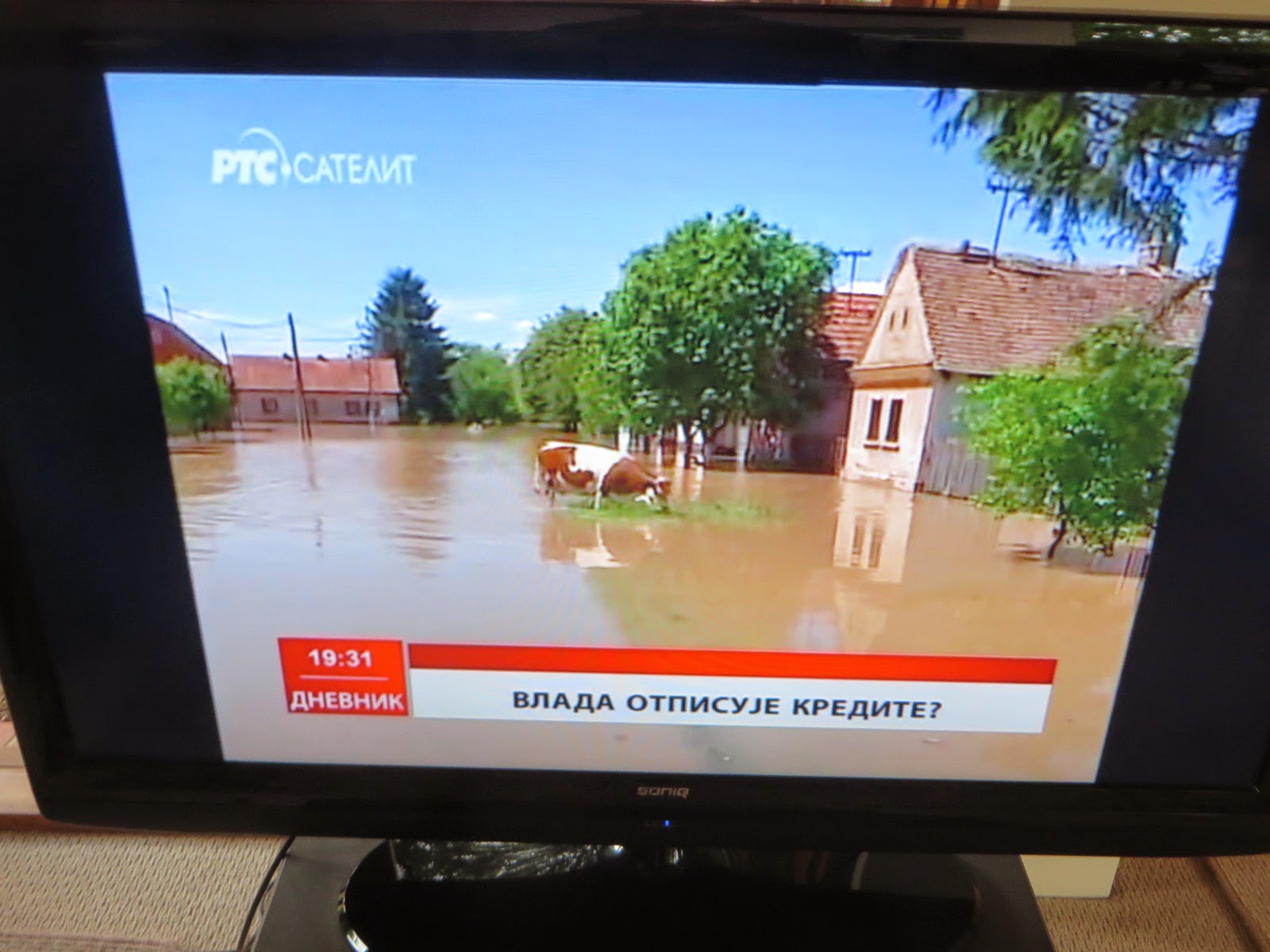
There has been some mention in the news of floods in the Balkans, and we were disturbed to receive a text from the cousins in Obrenovac (on the River Sava flood plain, and apparently one of the worst hit cities) to the effect that their whole town has been flooded and the family has been forced to find accommodation with friends and relatives.
At this stage, they don't know when it will be possible to return to their home, but early indications are that it might not be for some time. Unfortunately, there's not a lot that can be done from this distance to relieve the situation.
Update: we have now spoken to one of the displaced cousins. Naturally they are finding the whole situation distressing. They're critical of the lack of warning they received and the general "unresponsiveness" of the authorities (notwithstanding that the TV images convey a different impression).
At this stage, they don't know when it will be possible to return to their home, but early indications are that it might not be for some time. Unfortunately, there's not a lot that can be done from this distance to relieve the situation.
Update: we have now spoken to one of the displaced cousins. Naturally they are finding the whole situation distressing. They're critical of the lack of warning they received and the general "unresponsiveness" of the authorities (notwithstanding that the TV images convey a different impression).
Wednesday, 23 April 2014
The ANZAC tradition
It appears a lot of money is to be spent on commemorating the centenary of the ANZAC landing next year. However, the amount involved has raised eyebrows, for example in this ABC report.
However, in academia, apparently the issue goes a lot deeper than the money. The matter is the subject of an article in the April 2014 issue of Quadrant (Mervyn F Bendle, The Military Historians' War on the Anzac Legend). Bendle's article identifies a group of historians, including (strangely?) some at the Australian Defence Force Academy, who have have described the tradition in such terms as "Anglo-Celtic ...Anzac mythology [and] military fable". There seems to be quite an overlap between these people and those behind the Honest History website.
Bendle particularly takes to task the views put forward in recent books by Prof Joan Beaumont (Broken Australia: Australians in the Great War) and James Brown (Anzac's Long Shadow: The Cost of our National Obsession), but along the way mentions a number of other historians who have, in one way or another, taken issue with a number of the traditional and popular views of Australia's military history.

Let me say at the outset that I haven't carefully read the books that Bendle mentions, but I was taken by Bendle's colourful description of them as contributions to "the campaign of denigration of what is seen as a 'festival of mythology'". Bendle quotes Brown as stating, "This year an Anzac orgy begins. A commemorative program that would make the pharaohs envious". Brown is an ex-Army officer and an academic at the Australian Defence Force Academy. Bendle describes Brown's view of the Digger tradition "as a sort of cultural cancer within the military, promoting mythical ideas about the capabilities of Australian soldiers, and giving them ideas above their station." Hmm, a the risk of drawing a conclusion here, it sounds as though Brown thinks the tradition pays insufficient respect to the dignity that ought to be afforded to military officers as trained at the Academy.
Bendle notes that another historian in this category is Peter Stanley (author of Bad Characters, Sex, Crime, Mutiny and the Australian Imperial Fire, and who is quoted in the ABC report linked above), who includes in his criticism of the Anzac tradition the fact that it "unfairly favours old Anglo-Celtic families who [have] direct connections with those who served in and lived through the Great War", thus discriminatorily excluding "non-Anglo-Celtic Australians".
Joan Beaumont (these days also a Canberra academic) is said to have a wider range of issues with the tradition. Summarised, her views appear to be that the tradition insufficiently reflects the role of the women on the home front (such as, having actually to read in letters from the front about the miseries), as well as obscuring the memory of the 1917 general strike. She sees issues of the war years as leading to Australia in the 1920s as polarised between volunteers and shirkers, conscriptionists and anti-conscriptionists, Protestants and Catholics, workers and bosses and radicals and reactionaries.
Perhaps indeed history is multi-faceted, but the thought crossed my mind that some of these views seem to be in a similar category to an American historian writing about the effect that Paul Revere's ride had on his horse!
I notice, however, that the Weekend Australian is having none of this doubting! In the issue of 19-20 April, there was both an article by Peter Cochrane, referring to Anzac Day having been "reborn" as an appreciation of the trauma suffered not only by those who were directly involved but also by later generations in a variety of ways. And in the review section of that issue, an extract from Patsy Adam-Smith's 1978 work, The Anzacs, was published (although perhaps this isn't entirely unconnected with the fact that the book itself is being republished).
However, in academia, apparently the issue goes a lot deeper than the money. The matter is the subject of an article in the April 2014 issue of Quadrant (Mervyn F Bendle, The Military Historians' War on the Anzac Legend). Bendle's article identifies a group of historians, including (strangely?) some at the Australian Defence Force Academy, who have have described the tradition in such terms as "Anglo-Celtic ...Anzac mythology [and] military fable". There seems to be quite an overlap between these people and those behind the Honest History website.
Let me say at the outset that I haven't carefully read the books that Bendle mentions, but I was taken by Bendle's colourful description of them as contributions to "the campaign of denigration of what is seen as a 'festival of mythology'". Bendle quotes Brown as stating, "This year an Anzac orgy begins. A commemorative program that would make the pharaohs envious". Brown is an ex-Army officer and an academic at the Australian Defence Force Academy. Bendle describes Brown's view of the Digger tradition "as a sort of cultural cancer within the military, promoting mythical ideas about the capabilities of Australian soldiers, and giving them ideas above their station." Hmm, a the risk of drawing a conclusion here, it sounds as though Brown thinks the tradition pays insufficient respect to the dignity that ought to be afforded to military officers as trained at the Academy.
Bendle notes that another historian in this category is Peter Stanley (author of Bad Characters, Sex, Crime, Mutiny and the Australian Imperial Fire, and who is quoted in the ABC report linked above), who includes in his criticism of the Anzac tradition the fact that it "unfairly favours old Anglo-Celtic families who [have] direct connections with those who served in and lived through the Great War", thus discriminatorily excluding "non-Anglo-Celtic Australians".
Joan Beaumont (these days also a Canberra academic) is said to have a wider range of issues with the tradition. Summarised, her views appear to be that the tradition insufficiently reflects the role of the women on the home front (such as, having actually to read in letters from the front about the miseries), as well as obscuring the memory of the 1917 general strike. She sees issues of the war years as leading to Australia in the 1920s as polarised between volunteers and shirkers, conscriptionists and anti-conscriptionists, Protestants and Catholics, workers and bosses and radicals and reactionaries.
Perhaps indeed history is multi-faceted, but the thought crossed my mind that some of these views seem to be in a similar category to an American historian writing about the effect that Paul Revere's ride had on his horse!
I notice, however, that the Weekend Australian is having none of this doubting! In the issue of 19-20 April, there was both an article by Peter Cochrane, referring to Anzac Day having been "reborn" as an appreciation of the trauma suffered not only by those who were directly involved but also by later generations in a variety of ways. And in the review section of that issue, an extract from Patsy Adam-Smith's 1978 work, The Anzacs, was published (although perhaps this isn't entirely unconnected with the fact that the book itself is being republished).
Thursday, 3 April 2014
Being prepared for tsunamis
I was interested to come across this sign while in New Zealand.
I suppose, conceptually, it's similar to the bushfire safety zones that we now see in rural areas around Vuctoria.
Tuesday, 21 May 2013
Storm damage
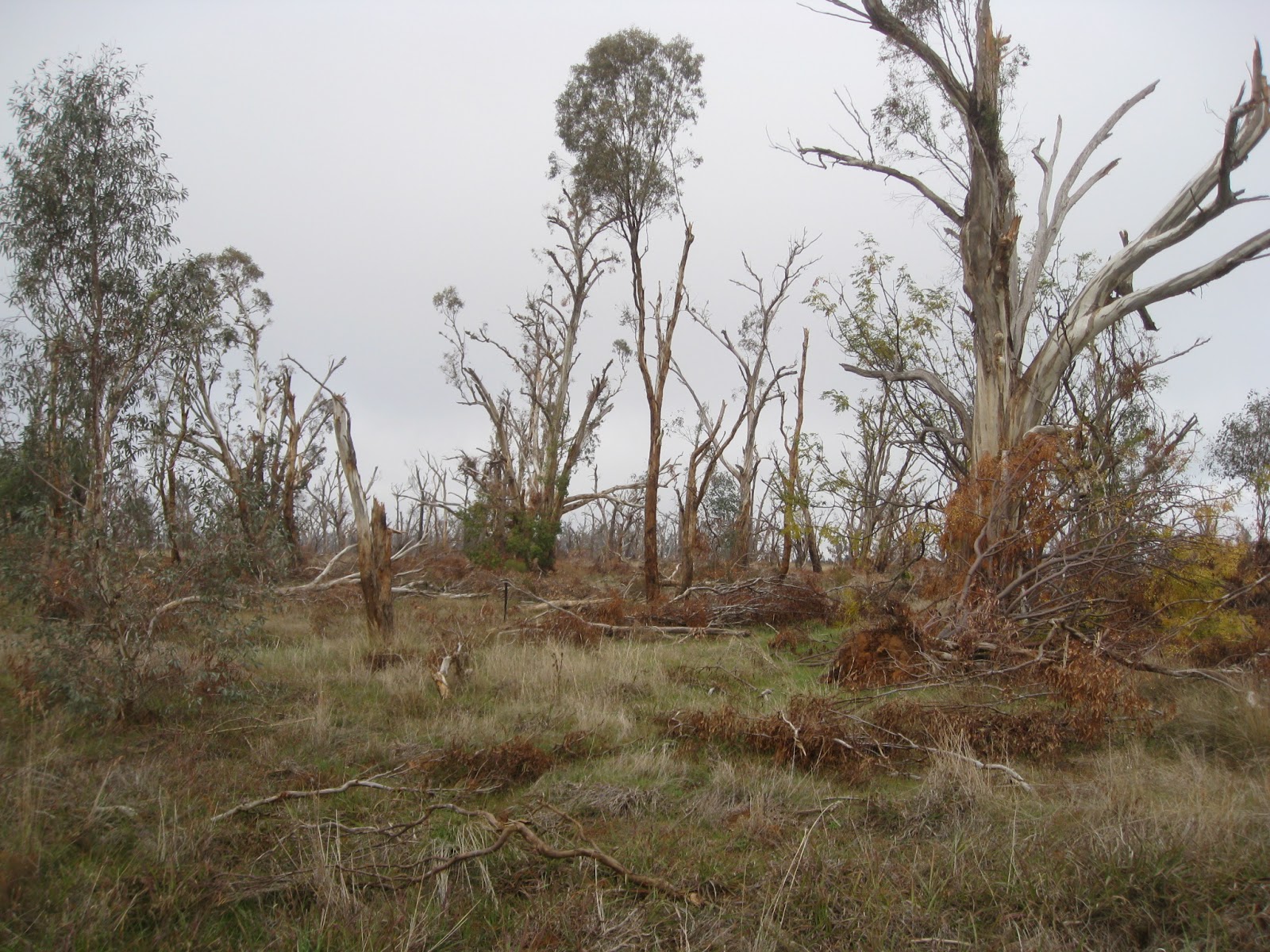
At first we couldn't work out why all the trees in a particular area were looking so bad. I wondered if there was some logging of red-gums going on, but it all looked a bit messy. We then realised that, up the road out of Mulwala, we were at the location of the bad tornado in March.
Saturday, 9 February 2013
Tsunami in Solomon Islands
Cath is working on an aid project in Vanuatu. She has told us that all is well in Vanuatu with no damage after the earthquake and tsunami in the region last Wednesday. There was a tsunami warning in Port Vila, but very little if anything came of it.
However, the Solomon Islands did suffer damage and she sent through the images below taken by Impact Assessment Teams that visited affected areas shortly afterwards. I haven't attempted to edit the captions.
Photos : Tsunami hits Solomons
After
the house was swept away by a Tsunami, the foundations mark the spot
where a home used to be, seen Wednesday Feb. 6, 2013, following
a Tsunami at Lata, Temotu province, Solomon Islands. The damage seen is
part a survey by the assessment crew of the aid organisation World
Vision. Solomon Islands authorities say at least four people are missing
and presumed dead after an earthquake triggered
a tsunami. Waves of up to 5 feet hit the western side of Santa Cruz
Island and damaged up to 80 properties. Dozens of aftershocks have
followed. Other tsunami warnings are canceled.
A
badly damaged home is seen Wednesday Feb. 6, 2013, following a Tsunami
at Lata, Temotu province, Solomon Islands. The damage seen is part
the survey by the aid organisation World Vision assessment crew.
Solomon Islands authorities say at least four people are missing and
presumed dead after an earthquake triggered a tsunami.
Debris
litters the partially destroyed Lata Airport, Solomon Islands,
following a Tsunami Wednesday Feb. 6, 2013. The damage seen is part
of a survey by the assessment crew of the aid organisation World
Vision.
Toppled
power lines lay in pools of water following a Tsunami Wednesday Feb. 6,
2013, in Venga, Temotu province, Solomon Islands. The damage
seen is part the survey by the assessment crew of the aid organisation
World Vision. Solomon Islands authorities say at least four people are
missing and presumed dead after an earthquake triggered a tsunami.
The
destroyed Venga village following a Tsunami Wednesday Feb. 6, 2013, in
Temotu province, Solomon Islands. The damage seen is part the survey
by the assessment crew of the aid organisation World Vision. Solomon
Islands authorities say at least four people are missing and presumed
dead after an earthquake triggered a tsunami.
In
a photo provided by Work Vision, a school is heavily damaged in the
area of Lata, Temotu province, Solomon Islands after a powerful
earthquake
off the Solomon Islands on Wednesday, Feb. 6, 2013 generated a tsunami
of up to 1.5 meters (about 5 feet) that damaged dozens of homes and left
at least four people missing and presumed dead in the South Pacific
island chain. [Edit: "Work"? Surely "World"!]
In
a photo provided by Work Vision, a village is destroyed in the area of
Lata, Temotu province, Solomon Islands after a powerful earthquake
off the Solomon Islands on Wednesday, Feb. 6, 2013 generated a tsunami
of up to 1.5 meters (about 5 feet) that damaged dozens of homes and left
at least four people missing and presumed dead in the South Pacific
island chain. [Edit, as above: "Work"? Surely "World"!]
Subscribe to:
Posts (Atom)