Showing posts with label People. Show all posts

Thursday, 14 August 2014

Buying a badge

I had a little talk to the guy diligently selling  "Vietnam" badges.    Or, rather, I lent him my ear for a couple of minutes.  He was quite happy to tell his stories, but he wasn't much of a listener!  Just for the record, he was an infantryman in 1 RAR.
 
And I'm not sure that I like the design of the badge (but I didn't tell him that), although I assume that it represents the Long Tan cross.


Monday, 28 July 2014

The Memorial Service

We attended a memorial Service for a long-standing member of the Church congregation.

About 150 people attended, and although the setting and format were traditional, many elements were, as happens these days, characterised as a celebration of her life, complete with reminiscences, grandchildren playing the cello and singing as well as Frank Sinatra recordings (and others) being played.  And then the refreshments afterwards spilled over into the worship space. 


All somewhat different from the orthodox tradition.


Thursday, 12 June 2014

Baba Rosa

Baba (S's mum) died on 10 June.   She was 89 (would have been 90 in September).

Although her passing is, of course, sad, she had a fair innings for a girl born in Bosnia who was taken to a labour camp in Germany during the war. She came to Australia as a refugee in 1950 on SS Nellie, where she spent time at the Uranquinty migrant hostel before making a new life in Melbourne, Christmas Hills and Canberra. 

Her funeral will be in Canberra on Saturday.

Friday, 23 May 2014

Monitoring social media

The following comment appeared on my post about the flooding in Serbia:
"Hello,
just wanted to let everyone know that you can support the victims of the flooding by playing the lotto. Here at Multilotto, we are giving €1 for every line played. Learn more here: http://www.multilotto.com/en/lotterynews/408-support-serbia-and-bosnia Whether you play the lotto or do something else entirely, please do what you can to support the victims of flooding in these difficult times.
Thank you."

The drama is on-going
Well, I like to receive comments, and the idea of providing financial assistance for the victims of the floods is commendable.  However,  I removed the comment because playing lotto on a non-Australian website doesn't seem the best way of supporting the victims (I understand that other ways of assisting them are under consideration).

Just the same, it's interesting that my rather obscure blog post was quickly picked up by the person who made the comment.   Obviously, there are some powerful tools out there monitoring the social media!  There was a similar instance here.

Tuesday, 20 May 2014

Floods in Serbia

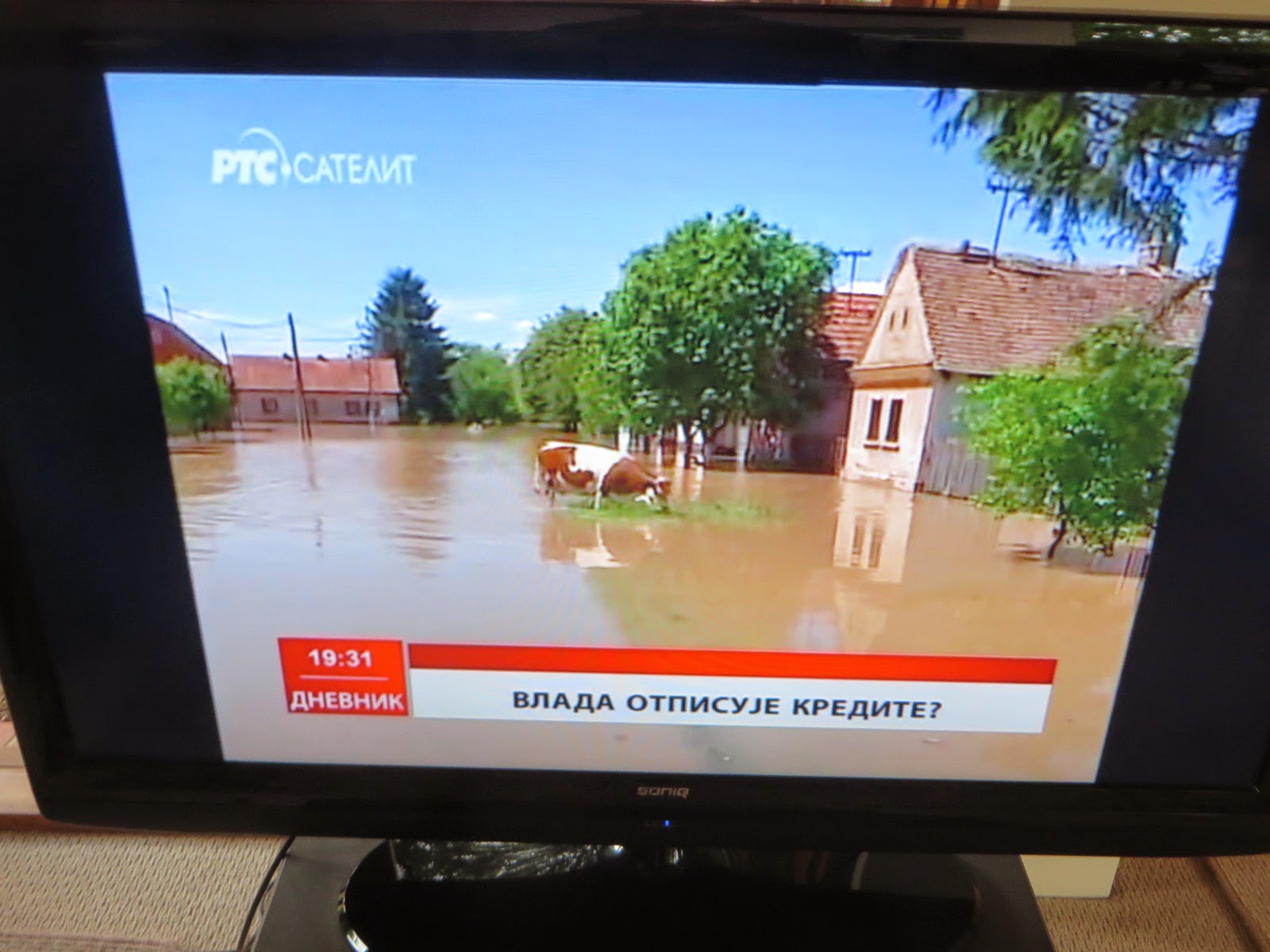
There has been some mention in the news of floods in the Balkans, and we were disturbed to receive a text from the cousins in Obrenovac (on the River Sava flood plain, and apparently one of the worst hit cities) to the effect that their whole town has been flooded and the family has been forced to find accommodation with friends and relatives.

At this stage, they don't know when it will be possible to return to their home, but early indications are that it might not be for some time.   Unfortunately, there's not a lot that can be done from this distance to relieve the situation.


Update:   we have now spoken to one of the displaced cousins.  Naturally they are finding the whole situation distressing.  They're critical of the lack of warning they received and the general "unresponsiveness" of the authorities (notwithstanding that the TV images convey a different impression).


Sunday, 18 May 2014

Perth

We had a leisurely lunch with some relatives (kumovi), which included a catch up with baby E (now 19 months and very attentive!).  

Freshwater Bay
Then we spent a few minutes checking the views over the Swan River at dusk, followed by an early dinner at - yes, predictably? - Cottlesloe again!    This time, it was at Indiana, which was very acceptable.   Pity it was dark so the ocean view was limited to the lights of the ships out at anchor.


Thursday, 8 May 2014

St George's Day

In the Orthodox (Julian) calendar, last Tuesday was 23 April  and the feast of St. George, the fabled dragonslayer and patron saint of many Serbs.

According to the legend, St George came upon a kingdom beset by a foul, plague-breathing dragon. To appease the dragon, they began to give it a daily sacrifice of livestock, and later even their children. When the saint came along and killed the dragon, the grateful citizens embraced Christianity.

In Serbian folklore, the feast of St George is the beginning of hayduk season - guerrilla resistance to Ottoman overlords that had conquered Serb lands in the 15th century. The season traditionally ended on the feast of Saint Demetrius (Mitrovdan), 26 October.
 
We attended Nata's slava, as St George is her family's saint.   As usual, there was lots to eact and drink.   A lot of self-restraint was needed!


Friday, 25 April 2014

H & M

So, what is it with H&M?  Sure, there's a new store at the GPO complex, but is it really that different or that interesting? 

Apparently, people think that it is - or that it's worth checking to if it is -  and are prepared to wait in a queue to find out!  No doubt a crowd attracts a crowd?


Thursday, 24 April 2014

Lunch at (or near?) Hanging Rock

Although it was wet, the great company made up for it when we had lunch a little while ago at M and R's place close to Hanging Rock.
Our view as we ate lunch!

Afterwards, we went past nearby Hanging Rock winery and did some sampling and took the opportunity to replenish the cellar.

That's the hen house

Hanging Rock winery

Tuesday, 4 March 2014

Kew - and being geographically footloose

I see that Tim Smith has won Liberal endorsement for the State lower house seat of Kew.  Hmm, until not so long ago, he was on the Stonnington council.  In fact, the that he is a former mayor of Stonnington is often mentioned as one of his credentials.  True, he did serve a term on the Council and he was mayor for one year during this time.  I think it's fair to say he is remembered as being reasonably effective and he was certainly high-profile.  He was (is) young and it was openly said of him that he had political ambitions.

But we read a little while back that Tim Smith has now been "locally active" in the Kew area and is president of the Canterbury branch of the Liberal party.

At Stonnington, he was a councillor for South Ward (Wikipedia still records this!).
 
Now, political ambitions are all very well, but most candidates in Stonnington find it necessary to assert a close interest in the local area.  I can't remember just what Tim Smith told us about his connection to the South Ward area, but Canterbury is quite some distance from Windsor, and no part of the Kew electorate is within kilometres of Stonningon's South Ward.  Perhaps geographic loyalty isn't all that it seems to be? [Edit] Or has he really moved house?

Sunday, 26 January 2014

The National Portrait Gallery

I've previously blogged with my thoughts about the National Portrait Gallery.    As I stated in that post, I quite like this Gallery.  In particular, a reasonable proportion of the art is relatively conservative. Ar least, that is, until you get into the "Australia Now" room.

I revisited the gallery when in Canberra and confirmed my belief that I don't really like the Princess Mary portrait, even though it still has a very prominent position.   And this time there was even a religious portrait (mind you, just one, at least so far as I could see), being Bishop Burgman. Even this work (on loan, and there because Judy Cassab's work was being highlighted) is an "interesting" choice.  I've always thought this secular trait in this Gallery suggests a particular "take" on its claim to select portraits of Australians who have been "significant in the field of endeavour".    For example, Eddie Mabo, Clarles Perkins, Neville Bonner and Harold Blair are all there, side by side.   And the Gallery has managed to obtain photographs of Lee-Lin Chin and Tim Winton.


Anyway, Whitlam and Kerr still hang side-by-side.   Menzies and Evatt are separated by two other portraits,  both politicians (one Liberal, one Labor).

There was a special display of Elvis Presley photos, but I didn't have a lot of time so decided not to pay the charge to enter this section.

[Edited 26 Jan 14]


Thursday, 12 December 2013

But has anyone actually bought a Holden recently....?

Yes, the loss of jobs at Holden is disappointing, but just how much in the way of government hand-outs would have been needed to save them?  And it seems we're not buying the cars they make anyway.

The media mentions that there are 3,900 jobs directly involved, and presumably there will be flow-on effects in suppliers and the like.

However, let's get this into context.   On gazing through the National Bank's annual report (please don't ask why I was doing this..... but it's here if you want to look at it), I noticed with interest the statement that NAB is "making significant progress in the convergence of 14,000 Melbourne-based employees into three locations....".

I was surprised that the number was as large as 14,000, but that's what the document states.   And presumably if they're going to be in three locations, this doesn't include staff working in branches.

Perhaps instead of worrying too much about the seemingly inevitable loss of manufacturing jobs, the powers-that-be ought to be taking steps to ensure that jobs in the service sector remain in this country, given the risk that at least some of these jobs could probably be moved to locations with lower costs.

Tuesday, 6 August 2013

The Guy in the Doorway

We were walking through the local shopping area recently during the evening.  In one of the doorways there was a man apparently settling in for the night.  He approached us, but it was during the evening and even though the immediate area had some lighting,  the night was dark and there were hardly any people around.    It's one of those decisions that you make quickly, but we ignored him and walked on.

I thought about our actions later, especially as this week is Homeless Persons' Week:  see here.

We are often told that homelessness is an issue in society (leaving aside all those definitional issues....seems it's broader than "rooflessness"), and of course we are sympathetic to people who are in this situation.  However, ought our sympathy extend to putting our hands in our pocket each time we encounter someone who looks to us?

It may be callous, but these days I'm generally reluctant to respond to people - usually males - who approach me on the street.  Frankly, the lack of gratitude, verging on abuse ("is that all?"), that I encountered on a couple of occasions some years back didn't help.    In our society, the fact that a person is "on the street" seems to me often to be a symptom of other issues.  Yes, domestic violence is said to be one such issue (although I'm doubtful if it's the issue so far as the males who approach you on the street are concerned), but there are others:   drug addiction, alcoholism, mental illness and so on.   There are agencies who work with people with these issues, and although in this area, no matter how well-resourced the agencies are, it will "never be enough", the services are in fact available.   Thus, my view is that my support ought to be directed to such agencies - as it indeed is - and that I am not bound to apply a band-aid every time I'm approached.

Tuesday, 2 July 2013

Marc Rich and "traders"

I see that Marc Rich died on 26 June 2013, aged 78.   Here's a link to the entry about him in Wikipedia.

Marc Rich was brought up and educated in the US and his early career included a stint at Philipp Brothers (as it was then known).   In 1974 he and co-worker Pincus Green set up their own company in Switzerland, Marc Rich & Co. AG, which has over the years morphed into what is now Glencore Xtrata Plc. Nicknamed "the King of Oil" by his longtime business partners, Rich has been credited with having created the spot market for crude oil in the early 1970s.   He was controversial for having traded oil with Iran, allegedly in defiance of US sanctions, and by some accounts, for "evading" large amounts in US taxes.   I've also heard that Marc Rich & Co made enormous profits during the breakup of the former USSR, trading commodities sourced there, the rumours suggesting that the source of such commodities wasn't always entirely clear.

No doubt others have and will write about Marc Rich and his colleagues.  My personal involvement wasn't with Marc Rich, of course, but I had some contact with the Marc Rich entity when it first started in Melbourne.  The people there most certainly had a "trader" mentality, and I clearly remember the disdainful attitude of the traditional miners to the development of this mentality.   They didn't like the fact that traders made money without "adding value".   I guess many of us would still endorse that view, but for better or for worse the traders and other intermediaries seem to be here to stay.  It's interesting, though, that the wheel appears to have turned somewhat, in that Glencore Xtrata now has very significant investments in production assets.

Wednesday, 19 June 2013

Lowering costs.....

The professional services firm with which I am associated has a strong European network.  It recently told us that it is opening a new office in Glasgow which will provide business support and legal services to its European offices, although the immediate plans are focused solely on support for London. It's all part of what is said to be "increasing demands for ... firms to take more responsibility for delivering services cost efficiently".  And keeping costs down so as to maintain profitability.........?

Perhaps this comes in the same category as near-shoring jobs to New Zealand?

Although out (near?)-sourcing from London to Glasgow is somewhat removed from out-sourcing from, say, Australia to an Asian country, there's a trend here.   There are many services that can be provided from a distance, especially in the "back office" area:  transcription of dictation, accounting functions, IT support and so on.  There are also fairly routine professional taks that can be undertaken remotely.  Presumably costs in Glasgow are cheaper  than in London, although I wonder if a Scottish location may also have something to do with contingency planning in the event of the Scots deciding to leave the UK?


Tuesday, 2 April 2013

J M Coetzee

If I had not read Summertime, I would have passed by the copy of J M Coetzee:  A Life in Writing on the new acquisitions rack at the library.  But Summertime intrigued me, and I was thus encouraged to look at this book, with a particular view to ascertaining to what extent Summertime was autobiographical.

The first thing that must be stated is that it's impossible in a note such as this to do justice either to Coetzee or to J C Kannemeyer's biography.
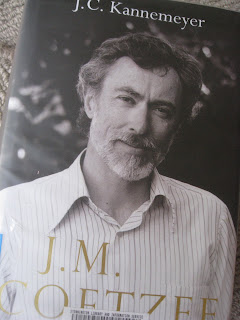
Coetzee has received numerous awards and honours, including the Booker prize twice (on neither occasion did he attend the presentation in person) and the Nobel Prize for literature, and Kannemeyer's monumental biography is impressive.  It contains a vast amount of information in its more than 600 pages.  True, the detail is sometimes a bit tedious, and things are occasionally out of sequence and there is some repetition, but overall, the reader is given a real insight into Coetzee the person and the events and circumstances that have influenced his writing.   No doubt this is assisted by the fact that, although a private person, Coetzee granted Kannemeyer interviews and put him in touch with family, friends and colleagues. Coetzee also provided him with comprehensive documentation in his private possession.  It appears that Coetzee has retained much of his personal correspondence and many of his draft manuscripts.  In fact, Kannemeyer was given access to the manuscripts for Slow Man - there were 25 versions!

The book  pays particular attention to the genesis of each of Coetzee's books, but it also touches on his marriage, divorce, subsequent relationship and some of the misfortunes that have affected his life (including his father's dishonesty and alcoholism and the death of his son when aged 23).  However, the emphasis is on his writing, and thus the work will be of interest to be students of literature.  I admit that, because of this focus,  I skimmed quite a few pages!

Just the same, it does deal the turmoil in the personal life and times of this enigmatic, elusive writer at a various stages of his career, including the stresses that Coetzee was placed under as an academic in the English faculty at the University of Cape Town during the height of the apartheid era, a regime that he strongly disagreed with.

Australians will be interested in the fact that Coetzee, who had not visited Australia until he was 50, elected to relocate to the Adelaide Hills in 2002 following his retirement from the University of Cape Town, notwithstanding his long connection with the United States (particularly the University of Chicago) and, to a lesser extent, Europe.   The reasons for this are complex, but appear to include his disillusionment with the political situation in the United States, the fact that he was not entirely comfortable in the English landscape (being accustomed to the spaces of the Koroo in South Africa) and the reaction of the ANC to Disgrace.  The latter is apparently sometimes said to be the reason for the move, but Kannemeyer states that, although this may have tipped the balance, it would be an over-simplification to attribute his departure from South Africa exclusively to it.  One factor seems to be that he was charmed by Australia!  He is also said to have considered that the issues in Australian politics are "trifling" compared with the big political themes involving meaningful national issues that arise in South Africa.

And the relationship of Summertime to Coetzee's own life?  This book was written in 2005-2009, in Adelaide.  In short, the setting of Summertime is fictional in that Coetzee never lived alone with his father and in that sense the work is not autobiographical.   Nevertheless,  the various scenarios described appear to derive from incidents in his life, although they have been modified and (perhaps) embellished.   In fact, even within the book, discrepancies are apparent, for example,  between what was said at one of the purported "interviews" and what is recorded.   Layer upon layer of complexity!    Apparently, the earlier works in of Boyhood and Youth are closer to being autobiographical; I must make a point of reading these.

Thursday, 7 March 2013

Ted

We had been out to a pleasant dinner and happened to turn the TV on when we got home (something that we often don't do).   There it was - Ted Baillieu had resigned!

Very surprising.   Obviously even the media had also been taken by surprise, given that one of the interviewees on the ABC was Jon Faine.  Of course, we've got used to journos interviewing other journos (or whatever, is Faine actually a journalist?) to create "news", but this did seem to suggest that the ABC had had to scratch around to find someone to interview (although they did also have Peter Reith).

My personal take on all this is that Ted is really "too nice" for modern politics.

This, of course, says a lot about politics, and the pressures placed on those in the public eye by the media.    However, I suppose we're unlikely to return to the more relaxed days of a past era when Prime Ministers travelled to Canberra by train (apparently John Curtin travelled between Perth and Canberra this way, playing bridge to pass the time!)

Tuesday, 5 March 2013

Maslenitsa

We visited "Maslenitsa - Slavic Pancake Festival" at Fed Square.   Traditionally, this celebrates the end of winter (well, in the northern hemisphere) and occurs before (eastern) Lent.  Thus, it's the last opportunity to have some non-fasting foods and to participate in some fun activities before Lent.  I guess there's a similar theme here to western Shrove Tuesday.

It was a lovely day, and it was well attended.   There was a range of activities, certainly not limited to pancakes - but they were there.   There was a series of performances on the stage by dance groups and singers from Russian, Serbian, Slovakian, Ukrainian and Polish groups (perhaps others as well), a number of very popular food stalls and a fair area.  

Kolo
According to the program, there were some events in which you could participate (including a ribbon carousel and tug-of-war). There was a kolo while we were there.

We encountered quite a number of friends and acquaintances, so there was a bit of catching up.  These included a former workmate of mine who I had not seen for over 25 years (he recognised me, but I only identified him after lots of clues!)


Main stage

Friday, 15 February 2013

Jim

Sadly, Jim Armstrong died last week and we attended his funeral today at the Carmelite Monastery, Kew.   He was 82.  There were a number of eulogies, and they certainly summed up the Jim that we knew:   a person with a strong set of values who held firmly to his principles and who was always determined to do the right thing.    In particular, he had a great sense of loyalty to those around him including those who worked with him.   He had a great collection of  (neck) ties - as we saw during the service - and he was certainly "into" technology, although it baffled him at times.  We were told that at one stage he had four mobile phones but struggled to send an SMS!

Jim - about to have lunch!
He liked eating out, and we were reminded that he was usually the last person at the table to order, and only then after discussing a number of options with the waiter. His order often included some minor modification to the item on the menu.  He would have a sweet "only to keep you company"!

He had not been well for quite some time, but those of us who had been in touch with him recently know that he continued to be as active as possible for as long as he could.  We would expect nothing less!

Lovely church and grounds, pity about the acoustics.


Rest in Peace, Jim.


(edited)

Saturday, 27 October 2012

Norma

A number of us travelled to Greensborough for Norma's funeral.   We had some inkling of her life, but learned a lot more during the service which was carefully planned to let those present see the overall picture.  Norma was a ward of the state from an early age and had a very tough time in unsuitable foster homes as a child, although she finally made it into a more caring environment.    A friend from that time was present, as was another from one of her first jobs.    She then gained work with an extremely supportive family who treated her as a member of their family for over 50 years, right up to the time she died.  It was not until quite late in her life that she had contact with her brother.

Living Faith Church, Greensborough
She was a conscientious attender at Armadale Uniting until just a few months ago, when she transferred to different accommodation, which was closer to the Greensborough church.  Her Church was important to her, as I found out when driving her most weeks in the last few years (after taking over from another Church member who had driven her for years).   

She was an enthusiastic and able knitter, until her extremely severe gout made this impossible for her.

It was a privilege to know Norma and to realise that she, like others of her generation,  endured some tough times.