Showing posts with label Railways. Show all posts

Thursday, 21 August 2014

Electioneering (2)

I had a quick word with the team installing the new signage at the local station, and commented that there must be an election coming on!    They tactfully responded that, yes, there had been a little pressure on them to get the work done!

Anyway, the new displays are kinda nice, although I reflect that, even though it's nice to know if the train is late or cancelled, there wouldn't be a need for all this information if the trains could be relied on to turn up when they're supposed to.  Moreover, the signs on the platforms only tell you what trains are running;  they don't 'fess up to cancellations (although they can give messages about disruptions).  You have to work out that a train has been cancelled by its absence on the display.

And Daniel Bowen wasn't too impressed with  the location of some of the signs.....


Friday, 18 July 2014

Caught smoking

As I've previously blogged, the train trip from Sydney to Melbourne takes 11 hours or more.   Obviously a long time to go between ciggies if you're a smoker, even if you're not going the full distance.   At many stations, only one or two doors are opened, and even at the bigger stations, passengers are strongly discouraged from getting off the train.  In fact, early in the trip an announcement was made that, because it's illegal to smoke on station platforms, it was no use smokers even trying to get off the train to have a quick light up.
A no smoking zone


Evidently all this was too much for one fairly young traveller on our train.  I happened to be moving about the train at the very moment that the train crew confronted him with the information that a remotely-monitored smoke detector had gone off in the toilet from which he had just emerged.

His denials didn't carry much weight as the crew (and I) could readily smell that he'd just had a cigarette.


He was escorted to the train manager's office, so I don't know what happened.  However, a few minutes later, a "final reminder" announcement was made that anyone caught smoking on the train would be fined and/or off-loaded at the next station.  Being off-loaded?   An option on the train, but wouldn't work so well for an airline!

Wednesday, 16 July 2014

Coffee, cakes and rain....

It was raining in Ballarat when we awoke, and it continued to rain for the entire trip home, via Creswick, Daylesford, Trentham and Woodend.     Bit as soon as we reached the outskirts of the city, the rain cleared - and we were told that it had hardly rained at all in Melbourne.
Creswick main street

At Creswick, unlikely though it may seem, there's a French-style patisserie (Le Péché Gourmand), so we stopped there for coffee and caramelised  pear slice.   After a quick drive-by of the Hepburn Springs to make sure they were still there, lunch at Daylesford was at the Food Gallery.  This gets mixed reviews, but we liked our meals (including gnocchi)..  However we were there on a relatively quiet and wet winter weekday, so they weren't under a lot of pressure.


Hepburn Springs - little has changed
We drove through Trentham, with coffee in mind, but none was obvious.   Since we had already stocked up on bread at Creswick so we passed on buying more at the Red Beard, but paused for more coffee and a chocolate slice (acceptable but not great) at Woodend before heading off on the last leg home.
Old railway wagons at Trentham - suffering in the weather

Friday, 11 July 2014

Electioneering (1): The Frankston Line

So, there's a state election due in November.  Given that our local station is served by Frankston line trains and there are a number of marginal seats along this line, I can see that this going to generate some bloggable material! I've previously mentioned that we've been seeing some money being spent on the line, although how it is that the painting of stations  (possibly at the expense of work needed elsewhere) will win votes, I don't know, but that's politics I guess.

In the meantime, a "Frankston line" election brochure produced by the Liberals has already arrived in our letterbox.  There's a website, too.  The messages are mixed:   things are better than they were and new trains will make things better.    Of course, the proposed airport rail link gets a mention, as well.  But there's a lot of negativity, too, as we are invited to recall that the service wasn't too good when the previous government was in office.   True, and, yes,  some improvements to frequencies were made shortly after the last election (the price being, elimination of most loop trains).   But if we are invited to recall the past, will we also remember the fact that a station at Southland was promised at the last election and is still nowhere near being built (and is being re-announced)?  Or that last January, the services for the whole month were reduced by 50%, with bizarre results during the peak periods?   Or that on a recent train trip, just a few days back, the in-train displays and announcements weren't working properly?
The brochure makes the point that there wasn't much movement on level crossing removals when the previous government was in office.  Well, although there's been some activity on this over the last four years (Springvale and out Mitcham way), the world hasn't exactly been set on fire in this respect during this Government's term, and certainly not around here (although action is now being promised, by both sides of politics).

To state the obvious, the issue is credibility.    Promises, promises.....   And I guess that applies to both sides of politics!

I wonder if similar publicity will be developed for other lines (such as the Dandenong corridor), although my limited googling didn't turn up any dedicated websites.

Thursday, 3 July 2014

The Cudgewa Line

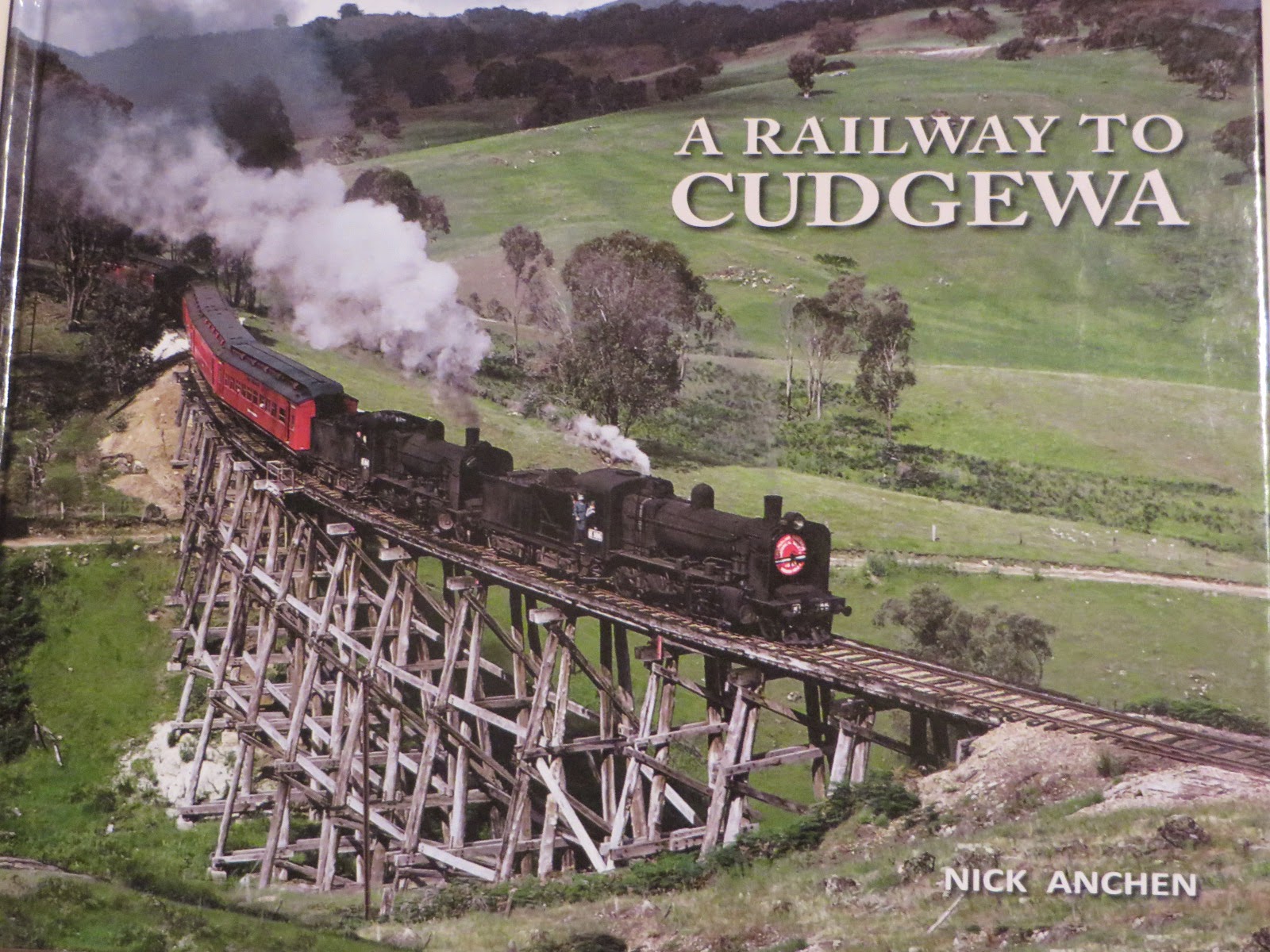
B lent me A Railway to Cudgewa by Nick Anchen.

This certainly brought back memories:  in my younger days, I travelled twice on this line, once on a goods train and once on an ARHS excursion.    I may even have some photos from that time, but I've yet to locate them.   Although these trips were good fun at the time, we took so much for granted then, and only in hindsight do we appreciate what we experienced.

As every Victorian railway enthusiast knows, Shelley was the highest station on the Victorian railway network (2562 ft).

Back to the book:  various chapters deal with the history of the line (including the relocation of the town of Tallangatta between 1952 and 1956), stories about the enginemen, the various trains that operated on the line, mishaps, the Snowy Mountains scheme traffic, the life of the bridge gangers and the eventual closure of the line.   There are many photographs, which really do contribute greatly to the book.

Friday, 27 June 2014

By train from Sydney to Melbourne


We took the train from Sydney to Melbourne.  In hindsight, I'm not quite sure why, but I suppose I wanted to be able to say that I'd done it.  And, I admit, there was a good fare available!

Well, there were a couple of positives, but there were a whole lot of negatives.

On the positive side, departing from Central involved just a short taxi ride from our accommodation, and the taxi pulled up almost next to where the train was.   No security, no hassles, just walk on board.  On the train, the seats are comfortable with a seat pitch of a metre (and that's in economy).   You can walk around and you don't need seat belts (out of force of habit I kept trying to do one up!)

On the negative side, it's a long trip.   Yes, XPT trains “can” run at 120 km, but for a lot of the time they don't.    There are stations to stop at, speed restrictions, curves and hills.  The trip from Sydney to Melbourne (about 960 kms, according to Wikipedia) is “scheduled” to take about 11 hours, which means the average speed is less than 90 kmph.  For a while, I enjoyed the ever-changing view, but once we got about half way, I did start thinking that perhaps I could have made better use of my day!  Fortunately, I had a good book to read.

There's food (and beer and wine) available for purchase, but although it's adequate, it's pretty basic.   There's no lounge car or even a place to eat what you buy except at your seat.

I was aware when I booked that the train only ran as far as Broadmeadows because of infrastructure work interfering with the run into Southern Cross.  I guess this should have sounded warning bells, but they weren't too loud, so I thought, oh well.

On the outskirts of Sydney, our train obviously got stuck behind a suburban train, which meant slow running for a while.  Then when we ought to have been powering up the hill to Moss Vale, things weren't quite as fast as I would have expected from an XPT train.  Somewhat later, we were informed that, yes, we were behind schedule, because one of the train's power units was not operating at full capacity.   Result, by the time we reached the outskirts of Melbourne, the train was over 30 minutes late.   Then, just before Broadmeadows station, where we were to disembark, to come to a stop.   We were told that, sorry, coz the train was 35 minutes late, it had missed its “landing slot”, and there would be a further delay of 30 minutes before we could get off.   So near, yet so far.  Finally, after waiting nearly 35 minutes at a place called Roxborough Park (actually, Somerton Loop for the gunzels) we got to the Broadmeadows platform, a grand total of 75 minutes late.  The transfer to buses went smoothly, and I suspect that the time the bus took to get into the city, down the freeway, was probably on a par with the time the train would have taken negotiating Melbourne's western suburbs.  Just the same, it wasn't the best end to a long day.

Bottom line?   I've ticked the "been there, done that" box, and will leave inter-city train travel in Australia in the future to the main users of the train, who are people travelling to and from the towns along the way to the "big smoke".


Wednesday, 11 June 2014

Growing Up on the Railway in the South West

I'm afraid that when I see a second-hand book shop, I can't resist wandering in and checking the railway books section.  So it was in Fremantle, where there's a branch of the Elizabeth's chain (pity there's no Elizabeth's in Melbourne).

I'm a bit selective about the types of book that I'm prepared to buy, and especially aren't attracted to generic books (such as "Steam Trains Around the World").  I look for books dealing with specific matters, such as researched histories of particular lines and reference materials (such as timetables).    So, the title "Growing Up on the Railway in the South West" didn't appeal to me when I first saw it, but in the absence of anything else of interest, I bought it.
 
I'm glad I did, because it's quite interesting.   It's a collection of recollections, all in the first person (but I suspect, told to the author) of a wide variety of people associated with the railways in the south west of Britain, especially (of course) the Great Western Railway.   It covers engineers, shunters, signalmen, porters, clerical workers, engine drivers, crossing keepers as well as a passenger and a chaplain.  There are reminiscences  from before World War 2 right up to the  publication date of 1998.  One chapter concerns the clerical worked who started work in 1917!  He retired in 1966, but apparently was still around at the time the reminiscences were being collected.  Thus, it touches on the effects of the depression, war, nationalisation, the passing of steam and the coming of diesels and there are even one or two mentions of privatisation. 


A few impressions emerged.  One is the length of time that some people worked on the railways.   In a number of cases, they started quite young in a very junior role and retired over 50 years later (although of course long-serving employees were more likely to have been chosen by the compiler).   One of the chapters is a daughter's recollections of her father who worked on the railway for over 40 years, but always refused promotion because it would have involved moving to a different town, even though his role was quite  mundane (although there are also instances of people who progressed through the ranks to quite senior positions).  And, especially in the pre-war era, transfers to other locations which today would seem to be quite close were regarded as going to a distant place!

Dr Beeching, and his widespread closures are frequently mentioned.   As I've remarked before, his is a household name, even today in British railway circles!

Another impression was the large numbers of people employed:  a contribution by a person who worked for many years as a shunter at the Swindon workshops refers to the fact that this establishment alone employed between 22,000 and 23,000 people (in the 1950s).  I'm not sure of the basis for this figure, as I see from Wikipedia that the peak employment was 14,000 and the figure in the '50s would have been less.  Perhaps the higher figure takes into account those employed in the proximity of the workshops, such as shunters and the like.  Nevertheless, on any view, the railways were clearly very significant employers.

Tuesday, 3 June 2014

Upgrading the railway line

There's been some publicity locally about a lot of money being spent on the local railway line.   I previously mentioned this here.  True, I'm aware that some modifications are required on the line so that a wider range of trains can operate on it, although $100 million seems a lot of money.  But there are some marginal seats along the line, and an election is getting closer.  Big amounts of money like this always scare me, but perhaps in the minds of our leaders, big figures are "impressive"?

However, it seems that some of work being undertaken isn't strictly needed, such as painting.  I'm only an observer, but it does appear to me that the paintwork at our local station was in reasonable shape - yet a crew has been here for days, re-painting.  On the other hand, maintenance on other parts of the network is said to be suffering, as Marcus Wong points out.  Is there an issue about priorities here?


Tuesday, 29 April 2014

A new station at Springvale

So, at great cost and amid fanfare, the level crossing has been removed and a new station has opened at Springvale.   I'm sure that this is very nice for the people in the area, although personally the closest I ever get, if I'm driving down that way, is the Westall Rd overpass.   But, there is no such thing as a free project and in addition to our taxes being devoted to this project (not that I'm seriously contending that it isn't worthwhile. even if expensive), the rest of us are also enduring 6 weeks of train cancellations while the train drivers learn to drive through the new station (and, it is true, areas affected by the regional rail works).

 Yes, it's just a train here, and a train there, and the cancellations vary from day to day (seemingly, though, the same trains are cancelled on the same day for each of the 6 weeks), but they do include a number of peak services as well as (on our line) one instance where two trains in a group of 3 won't run.


And although there's been a bit of a splash at our local station about "improvement" works occurring on our line (is there an election coming on?), there's nothing there giving any tangible information, such as telling us which trains are cancelled (or, for that matter, even just alerting us to the fact that cancellations are being scheduled).

I know that trains are different from trucks, but I've never noticed the trucking industry being disrupted for a few weeks when a new road is opened so as to allow for truck driver training!

Monday, 14 April 2014

A train to the Airport

Well, we've had an announcement that there's going to be an announcement about a rail link to the airport. It's all vague at this stage, but we keep reading that lots of Melbournians want a train to the airport - and there's an election coming later this year!   Daniel Bowen was quick off the mark with his as-ever sensible comments (although that's not to say I agree with everything he says) 

Yes, a rail link would be nice, but, really, is this the best use of our urban transportation dollars? 

The starting point has to be the existing Skybus service.   Unfortunately, it isn't perfect, especially when compared to services such as Narita airport's "Limousine Bus".   We haven't been to Tokyo for some years, but when we did, there was an counter inside the terminal with helpful staff to assist (instead of a booth outside on the pavement), and you were allocated a set departure time for a bus service that often took you directly to the part of town where you wanted to be (including a number of major hotels).  

Wouldn't fixing up Skybus be a lot cheaper than a new rail line?  Crikey thinks so.  Additional buses could add to the frequency and if there are delays at certain times of the day at the airport end of the freeway (which I'm told is the case), then a dedicated roadway (elevated if necessary) for buses as they neared the airport would be a lot cheaper than a rail line (even if it's now going to be elevated instead of underground).

Yes, Skybus costs $18 one-way (cheaper if you buy a return ticket).   But does anyone seriously think that there wouldn't be a premium charged at an airport railway station?   And let's not forget that the basic Heathrow Express fare is now £21.

Skybus operates 24 hours a day.  Would a train do that?   Further, Skybus is door to door (via a connecting shuttle) if staying in the city (6am - 10.30pm Mon - Fri and 7.30am - 5.30pm weekends).

Monorail?
Another issue in relation to a train is the route.   Public Transport Victoria has recommended the so-called Albion East route - but in their report it was integrated with the Metro tunnel, and there's no sign of that happening.   It now seems that this isn't a requirement (and in fact, my hunch is that an airport rail link is likely to squeeze out funding for the Metro proposal).  Perhaps we'll end up with a service into Southern Cross via the new regional rail tracks.  A 10 minute frequency to the airport would run the risk of creating congestion on this line, although Daniel Bowen seems relaxed about this.

At least the proposal for a monorail that briefly flickered across our TV screens a little while back seems to have flamed out.  Hopefully we've heard the last of this.

Tuesday, 8 April 2014

Confusion on Metro

Things can be confusing on Metro at times.   Perhaps the worst problems are with the automated announcements and signs in the trains.  These regularly provide incorrect information, such as the announcement and sign in the train this week that stated, as the train was arriving at Flagstaff, the next station was Parliament (2 stations back).   And this is by no means an isolated example.

There are also regular issues at Flinders Street, too. Last minute platform changes are perhaps inevitable, but so often the announcements are unclear at best and confusing at worst.

But there's unnecessary confusion programmed into the system, too.  A classic example is the recorded announcement regularly made at Richmond, when a train running direct to Flinders Street is approaching.  The recording states that the train will "stop at all stations".    I have looked in vain for a new station to service the tennis centre or the MCG, but to the best of my knowledge, there are still no stations between Richmond and Flinders Street.

Tuesday, 25 March 2014

Dunedin

I took the excursion train up the Taieri Gorge. Like the Arthur's Pass excursion, this was well worth while, with most impressive scenery. Of course, it wasn't cheap, but it departed from the wharf, alongside the ship. The line is operated as a tourist attraction, and seems well patronised and very well organised. The return trip took over 4 hours, but this included some stops. In addition to the 15 carriage special train operated as an excursion for the cruise passengers (who were supplied on board with coffee, soft drinks, beer and lunch with white wine), the normal train operated two trips, both of which we saw (one at the terminus, and one on our return) and both were well patronised.


The gorge scenery can only be appreciated from pictures, one of which is here and I'll post more when I can (now done).


As mentioned in the previous post, we'll now be at sea with no affordable internet until our return.   The ship is preparing to depart, and there's a piper on the wharf as evidence of Dunedin's Scottish heritage.


Dunedin station

Akaroa and the TranzAlpine

No blog post from Akoroa because I was too occupied to go looking for an internet connection, which probably didn't exist anyway.

The cruise ships now call at Akoroa instead of Lyttelton because the berthing facilities at Lyttelton were apparently damaged in Christchurch's earthquakes and haven't yet been restored. Akoroa is out on the Banks Peninsula and has a French heritage. Cute, it seems, but just a small town.

However, I didn't have time to look at it because I booked for the train excursion on the TranzAlpine. This is referred as one of the world's top scenic train trips, and so it proved to be: amazing views as the train ascended to Arthur's Pass alongside the river. The not-inexpensive excursion doesn't have time to do the whole TranzAlpine trip to Greymouth. It was advertised as bus to Arthur's Pass to pick up the train returning from Greymouth (presumably because there are spare seats on the return trip) but in fact it seems that a special train was operated to cater for the excursion from our ship as well as another ship in port. So, we had an uphill trip. I thought, this will be better, because the train will have to go more slowly up to the pass. Not so: this is mostly 100 kmph track (!!), and the 10 or so carriage train really rattled along! 
 

There are a couple of open observation cars, which were fun to stand in, but you certainly had to hold on to the rails (and to your camera).


To get to Rollestone, where we joined the train, it was necessary to travel by bus across the Banks Peninsula. Again, the scenery was great as the road wound up to the “Hilltop” and then down again. 
 
Banks Peninsula

However, my pre-conceived idea that this peninsula would be forested was totally wrong: most of the hills are quite denuded of trees, with only odd patches of trees. The bus driver stated that the original forests had been logged in the early days. I haven't checked whether this is the case, but if it is, they certainly did a good job with the clear felling.

This post is from Dunedin, where I did another rail excursion (details in later post).

We'll be at sea from this evening until we return to Melbourne, although a cruise through the fjords will occur tomorrow.


[Further images added]

Tuesday, 18 February 2014

Enginemen of the Victorian Railways

B lent me Enginemen of the Victorian Railways, in two volumes, by Nick Anchen.  These are collections of reminiscences by engine drivers and firemen, focussing on their experiences on steam locomotives and also (in the second volume) on rail motors, but there are some stories from the diesel era, too.   Numerous excellent photos (many in colour) are included.

For me, it was fascinating reading, especially being able to relate to many of the railway lines mentioned. It's clear from the acknowledgements that although the author has presumably collated the material, he has drawn on interviews conducted by others, at least some of which have been broadcast on Eastern FM.

Obviously, working on steam locomotives was often not romantic in the slightest, although it's said that many of the locos had personalities of their own.    The shifts were sometimes long and at awkward times, the conditions for overnight rest breaks were poor and at least for the fireman, the work often involved a lot of physical effort.    On the other hand, there are several stories about the "highs" of the job, such as driving the S class on the Spirit of Progress and the single H class loco, Heavy Harry.


Other themes that come out are the distinction between the enginemen (who, in the Victorian Railways, came under the Rolling Stock Branch) and other employees, in different branches.   The career structure for an engineman typically started in the workshops, progressing as a cleaner and hostler in the loco depot before becoming a fireman and finally driver.  In the 1930s, promotion was often slow.   Guards and station staff were in Traffic Branch. It emerges at a couple of points that often there was no love lost between these branches,  or between them and the Ways and Works Branch (including gangers and the like).

But even on the footplate there were sometimes issues between the men.   Although the driver and fireman often worked as an effective team, mention is made of at least one "old school" driver who produced a piece of chalk and drew a line down the centre of the cab, informing the young fireman that he was to stay on his own side.    Another driver had a habit of drinking a bit too much before arriving at work, until all the firemen refused to work with him.   Other depots were renowned for their friendliness.

R765 at Guildford on an excursion train to Avoca, 4 Nov 1964
There are lots of stories which give an insight into life on the railways in the days of steam.   Many are about things going wrong and people getting up to mischief, such as the guard who hopped off the train to collect mushrooms and then couldn't get back on it.   I guess these are the aspects that are remembered and make the best stories!

Tuesday, 4 February 2014

The railway museum in Canberra

The Australian Railway Historical Society has a large collection of railway equipment on part of what used to be the goods sidings close to Canberra station.  Some of it is yet to be restored (such as a former "Southern Aurora" carriage). However, there's an impressive collection on display and open for inspection. 
I visited the museum when in Canberra.  It's clear that a lot of work has already gone into it.  The items on display include a number of locos and also other equipment such as carriages (including a former buffet car and a sleeping car), a ganger's trolley and more. 


Of course the star attraction is the 60 class Bayer Garratt loco  (number 6029).     I was told that the restoration work on this has reached a stage where the loco will soon be in a position to operate!


However, I found the carriages and rolling stock fascinating, too.  It doesn't seem all that long ago when this was the way we travelled.


The rail motor is operational and I went for a short ride on it.

Driver's view from rail motor